
How to Choose an Infrared Heating Panel: A Buyer’s Checklist
You have one cold room. You have looked at infrared heating panels, and now you are staring at a product page that says "900 W carbon fiber far infrared panel, IP44, smart thermostat, 5-year warranty" and you are not sure what any of it means for your basement office or your tiled bathroom at 6 a.m.
This checklist walks you through the nine things to check before you buy. Each one answers a question you would ask a friend who already has a panel on her wall: Is it safe? Will it heat my room? Can I plug it in or do I need an electrician? What happens if it breaks?
Work through the list in order. If a panel fails any of the first three items, stop reading that product page and move on.
The checklist at a glance
- Confirm a UL, ETL or CSA listing before anything else. No listing means no safety testing you can verify.
- Match wattage to your room: a rough starting point is 10 watts per square foot for a well-insulated room with an 8-foot ceiling.
- Decide between 120 V (plug-in, up to about 1,500 W on a standard circuit) and 240 V (hardwired, higher wattage, needs a licensed electrician).
- Look for a stated surface temperature in the spec sheet. If the manufacturer will not tell you, that is a warning sign.
- Check the thermostat type: built-in, external line-voltage, or smart. Each has trade-offs in cost and control.
- Verify the damp rating (IP code) if the panel goes in a bathroom, garage or any space where moisture is present.
- Read the warranty terms for what is covered, for how long, and whether support is US-based.
- On marketplaces, watch for missing listings, vague specs, and prices that seem too good for the wattage.
Checklist item 1
Safety listing: UL, ETL or CSA
Every electrical product sold in the US should carry a listing from a Nationally Recognized Testing Laboratory. The three you will see on infrared panels are UL (Underwriters Laboratories), ETL (Intertek) and CSA (Canadian Standards Association). A listing means an independent lab tested the panel against a published safety standard and found it safe under normal use.
Look for the mark on the product itself, in the spec sheet, or in the listing description. If a panel has no listing and the seller cannot name one, do not buy it. This is not a formality. A panel that overheats, shorts or melts its wiring is a fire risk, and a listing is the only way you can verify that someone checked.
Some sellers write "CE certified" and leave it at that. CE is a European conformity mark. It tells you the product meets EU requirements, not US requirements. A CE mark alone is not enough for a US home.
Checklist item 2
Wattage: how many watts your room needs
Wattage is the rate at which the panel converts electricity into heat. A 600 W panel puts out 600 watts of thermal energy per hour. That is the same as a 600 W space heater, but the heat arrives differently: an infrared panel warms surfaces and people in its line of sight, the way the sun warms your face on a cold, still day. A space heater warms the air around it, and the air then moves around the room.
A rough starting point for a well-insulated room with an 8-foot ceiling is 10 watts per square foot. A 12 by 12 room is 144 square feet, so 144 times 10 equals 1,440 watts. Round up to the nearest panel size you can find, so a 1,500 W panel or two 750 W panels.
That 10 watts per square foot assumes the room is reasonably insulated, the ceiling is 8 feet, and the panel is the only heat source in that room. If the room has a lot of glass, a high ceiling, or is a basement with a concrete floor, you may need 12 to 15 watts per square foot. If the room already has baseboard heat and the panel is just taking the edge off, 7 to 8 watts per square foot may be enough.
The honest answer is that no single number works for every room. Use the calculator below with your own measurements and your own insulation assumptions.
Wattage estimate for your room
Enter your room dimensions and a watts-per-square-foot figure based on your insulation. The result is a starting point, not a guarantee.
Estimated wattage needed W
Voltage: 120 V plug-in or 240 V hardwired
This is the decision that changes everything else: what you can buy, what it costs to install, and whether you need an electrician.
Most US homes have 120 V circuits for outlets and lighting. A standard 15-amp circuit can carry 1,800 watts total (120 volts times 15 amps). A 20-amp circuit can carry 2,400 watts. But you should not load a circuit to its maximum. The National Electrical Code recommends keeping continuous loads at 80 percent of the circuit rating, so a 15-amp circuit should carry no more than 1,440 watts of continuous load.
That means a 120 V infrared panel tops out around 1,500 watts on a dedicated circuit, and less if the circuit already has lights or other devices on it. If your room needs more than 1,500 watts, you either use two panels on separate circuits or go to 240 V.
A 240 V panel draws the same wattage at half the current. A 2,000 W panel on 240 V pulls about 8.3 amps (2,000 divided by 240). That is well within a 15-amp or 20-amp 240 V circuit. But 240 V circuits are not standard in most US rooms. You need a licensed electrician to run a dedicated 240 V circuit, which adds cost and scheduling.
| Factor | 120 V panel | 240 V panel |
|---|---|---|
| Max wattage on one circuit | About 1,500 W (15-amp circuit at 80% load) | About 3,000 to 4,000 W (20-amp circuit at 80% load) |
| Installation | Plug into a standard outlet or hardwire to an existing 120 V circuit | Requires a dedicated 240 V circuit run by a licensed electrician |
| Current draw for 1,500 W | 12.5 amps | 6.25 amps |
| Best for | One small room, renters, plug-and-go setups | Larger rooms, sunrooms, garages, whole-room heating |
| Added cost | None if you plug in; minor if you hardwire to an existing circuit | Electrician labor plus breaker and wiring, often several hundred dollars |
| Portability | You can unplug and move it | Fixed to the wall once installed |
Checklist item 4
Surface temperature
Infrared panels work by radiating heat from a warm surface. The surface temperature tells you how hot the panel gets during normal operation. This matters for two reasons: safety (can a child or a pet touch it without getting burned?) and clearance (how much space does the panel need from the wall, the ceiling, or nearby objects?).
A good manufacturer states the surface temperature in the spec sheet, often something like "maximum surface temperature: 185°F." If the spec sheet is silent on this, ask the seller. If they cannot answer, that is a red flag.
Panels with a surface temperature above 140°F can cause a burn in a few seconds of contact. If you have small children, look for a panel with a lower surface temperature or a protective grille. Some panels stay under 120°F on the front face while still radiating useful heat, because the infrared energy passes through the surface without requiring it to be extremely hot.
Clearance requirements are usually stated in inches. A typical wall-mounted panel needs 2 to 4 inches of air gap behind it and 12 to 24 inches of clearance below and to the sides. Check the manual, not the listing.
Checklist item 5
Thermostat type
A panel without a thermostat runs at full power until you switch it off. That is wasteful and uncomfortable. You need some way to set a target temperature and let the panel cycle on and off to hold it.
There are three common options:
Built-in thermostat. The panel has a temperature sensor and a control dial or digital display on the unit itself. Simple, no extra wiring, but the sensor reads the air temperature right next to the panel, which can be warmer than the rest of the room. You may need to set it a degree or two higher than you want the room to feel.
External line-voltage thermostat. A separate wall-mounted thermostat wired between the power supply and the panel. The thermostat sits at a representative spot in the room, so it reads the actual room temperature. This is the most accurate option for a fixed installation. It costs more and requires wiring, but it is what a professional installer would use.
Smart thermostat or app control. Some panels connect to Wi-Fi and let you set schedules from your phone. Convenient if you want the panel on before you arrive home. Check whether the app works with your router and whether the manufacturer supports it long-term. A panel that loses app support in two years is a panel you cannot control.
Mounting options
Infrared panels are usually wall-mounted or ceiling-mounted. Some come with a freestanding frame, but that is less common and takes floor space, which defeats one of the main reasons people choose a panel.
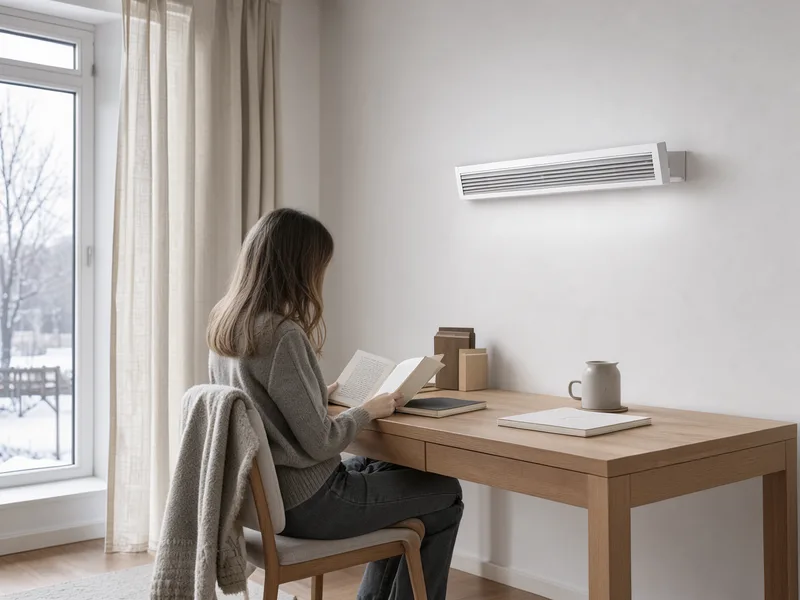
Wall mounting is the default. The panel hangs flat against the wall, usually 6 to 8 feet above the floor, angled slightly downward if the manual allows. You need a stud or a rated anchor for the mounting bracket. A panel that weighs 15 to 25 pounds is not heavy, but it is not light either, and a drywall anchor rated for 10 pounds will fail.
Ceiling mounting works well in rooms with high ceilings or limited wall space, like a garage workshop or a sunroom. The panel radiates downward, warming the floor and the people standing on it. Ceiling panels often need a higher wattage because the heat has to travel farther to reach you.
If you are renting, a plug-in panel on a freestanding stand or a panel mounted with removable adhesive strips (if the manufacturer approves it) lets you take it with you when you move. Check the manual before using any mounting method the manufacturer does not list.
Checklist item 7
Damp rating: the IP code
If the panel goes in a bathroom, a garage, a covered porch, or any space where moisture, dust or splashing water is possible, check the IP rating. IP stands for Ingress Protection, and it is a two-digit code. The first digit rates protection against solids (dust, debris). The second digit rates protection against liquids.
IP20 means no special protection against water. Fine for a dry bedroom or office. IP44 means protected against splashing water from any direction. Suitable for a bathroom where the panel is not directly above the shower. IP65 means protected against water jets. Suitable for a garage or a covered outdoor area.
A panel rated IP20 in a bathroom is a safety risk. Condensation can reach the internal electronics and cause a short. Match the IP rating to the room.
Checklist item 8
Warranty and US support
Read the warranty terms, not just the headline number. A "5-year warranty" that covers only the heating element and not the thermostat, the wiring, or the housing is not the same as a 5-year warranty on the whole unit. Look for what is excluded, whether you need to ship the panel back for repair, and whether a replacement or a refund is offered.
US-based support matters. If the manufacturer is overseas and support is by email with a 48-hour response time, you are on your own for installation questions, warranty claims, and replacement parts. A US phone number or a US-based support team is a practical advantage, not a luxury.
Some panels sold on marketplaces have no warranty at all, or a warranty that is only valid if you bought from an authorized reseller. Check the seller's return policy separately from the manufacturer's warranty. They are not the same thing.
Checklist item 9
Marketplace red flags
Infrared panels are still uncommon in the US, and many listings on Amazon, Walmart and other marketplaces are from overseas sellers with no US presence. Here is what to watch for:
No safety listing. The listing says "CE" or "FCC" but not UL, ETL or CSA. FCC is a radio interference certification, not a safety certification. It does not mean the panel is safe to plug into your wall.
Vague or missing specs. No wattage, no surface temperature, no IP rating, no dimensions, no weight. If the seller cannot be specific, they may not know what they are selling.
Prices that do not match the wattage. A 1,500 W panel for $40 is not a deal. The heating element, the housing, the wiring and the safety testing all cost money. A suspiciously cheap panel is either underpowered (it says 1,500 W but draws 800 W) or unsafe (no listing, thin wiring, no thermal cutoff).
No model number or brand you can look up. If you cannot find the manufacturer's website, you cannot find a manual, a warranty claim form, or a support number. You are buying a mystery box.
Reviews that all sound the same. A handful of five-star reviews with identical phrasing and no photos are likely fake. Look for reviews that mention specific details: room size, how long it takes to warm up, whether the thermostat is accurate, whether the seller responded to a question.
Common questions before you buy
Do I need an electrician to install an infrared panel?
Not always. A plug-in 120 V panel that you mount to the wall and plug into an existing outlet needs no electrician. A hardwired panel, or any 240 V panel, needs a licensed electrician to run a dedicated circuit and connect the wiring. The electrician's job is the circuit, not the panel itself. Mounting the panel to the wall is a DIY task if you can use a drill and a level.
Can I use an infrared panel in a bathroom?
Yes, if the panel has an IP rating of at least IP44 and is installed outside the direct splash zone of the shower or tub. Check your local electrical code for the required distance from water sources. In most US jurisdictions, a GFCI-protected outlet or circuit is required for any electrical device in a bathroom.
How long does an infrared panel last?
A well-made panel with a UL or ETL listing should last 10 to 20 years with no moving parts to wear out. The heating element (carbon fiber, ceramic, or a metal alloy) does not degrade quickly under normal use. The thermostat and any electronics are the parts most likely to fail first. A warranty that covers the whole unit, not just the element, is a better indicator of expected lifespan.
Is a 120 V panel enough for a 12 by 12 room?
A 12 by 12 room is 144 square feet. At 10 watts per square foot, you need about 1,440 watts. A single 1,500 W panel on a dedicated 15-amp circuit will cover it, provided the circuit is not already loaded with other devices. If the room has poor insulation, a high ceiling, or a lot of exterior wall, you may need a second panel or a 240 V unit.
What is the difference between far infrared and near infrared in a heating panel?
Far infrared (wavelengths around 5 to 15 micrometers) is what most heating panels emit. It warms surfaces and people gently, like the warmth you feel from a stone wall that has been in the sun all day. Near infrared (shorter wavelengths, around 0.7 to 2.5 micrometers) penetrates deeper into skin and is used in therapy lamps and saunas. For room heating, far infrared is what you want. A panel that advertises "near infrared" for room heating is either confused or trying to sound more advanced than it is.
Can I use an infrared panel with a timer or a smart plug?
Yes, a plug-in panel can be controlled by a smart plug or a mechanical timer. This is a cheap way to get scheduling without buying a panel with built-in Wi-Fi. Just make sure the smart plug is rated for the panel's wattage. A smart plug rated for 1,500 W will handle a 1,500 W panel, but it will not handle a 2,000 W panel. Check the rating on the plug itself.