

Infrared Heating Panels: The Complete Guide for US Homes
You have one room that never gets warm enough. Maybe it is a basement office where your fingers go stiff by mid-morning. Maybe it is a tiled bathroom at six in the morning, or a garage workshop where the concrete floor steals every degree. You have tried a space heater, and it blows dust around and takes up floor space. You have considered a mini split, and the quote made you flinch.
Infrared heating panels are a middle option that many Americans have not heard of yet. They are common in the UK, Germany and the Netherlands, and they are starting to show up in US homes. They sit flat on a wall, stay silent, move no air, and warm you the way sunlight warms your face on a cold, still day. This guide walks you through how they work, how many watts you need for your room, what they add to your monthly electric bill, and whether you can plug one in or need a licensed electrician.
Contents
- How an infrared panel actually warms you
- How many watts you need for your room
- What a panel adds to your monthly electric bill
- Plug in or hire an electrician
- Types of infrared panels you will find
- When a panel is the wrong choice
- Safety and certifications to look for
- Common questions about infrared heating panels
Key takeaways
- Infrared panels warm people and surfaces directly, not the air, so you feel warm even if the room temperature reads a few degrees lower.
- A typical supplemental setup runs 10 to 15 watts per square foot for a well-insulated room with 8-foot ceilings.
- A 600 W panel running 6 hours a day at 16 cents per kWh adds roughly $17 to your monthly bill.
- Most panels under 1,500 W can plug into a standard 120 V outlet, but you must check your circuit load first.
- A panel is the wrong choice when you need to heat an entire house, when a cheap space heater covers an hour a day, or when your wiring cannot handle the load.
How an infrared panel actually warms you
An infrared heating panel is a flat, thin panel, usually 1 to 2 inches thick, that you mount on a wall or ceiling. Inside it, an electric element heats a surface to roughly 80 to 120 degrees F. That warm surface sends out infrared radiation, which is the same kind of energy the sun sends to your skin. The radiation travels in straight lines until it hits something solid: your body, a desk, a chair, a wall. That object absorbs the energy and gets warmer.
This is different from a space heater or a baseboard, which work by convection. A convection heater warms the air touching it, the warm air rises, cooler air sinks to replace it, and a slow circulation loop builds up. The air in the room gets warmer, and you feel warm because the warm air touches your skin. Infrared skips the air step. You feel warm even if the air temperature is a few degrees lower, because the radiation is hitting you directly.
Think of it this way. On a cold January day, you can stand in the sun and feel warm on your face while the air around you reads 30 degrees F. That is radiant heat. An infrared panel does the same thing indoors, just at a much lower intensity and without the UV component.
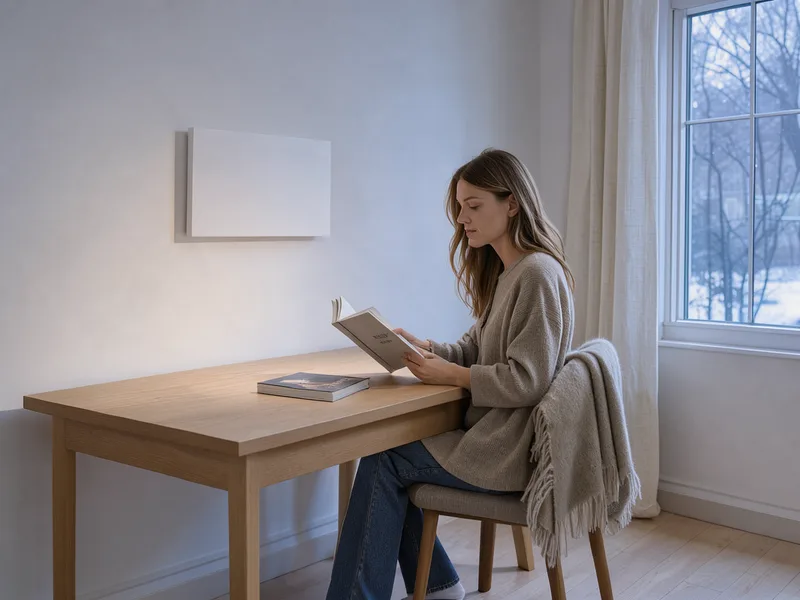
Who infrared panels suit, and who they do not
Panels shine when you need to warm one person in one room, quickly and quietly, without moving air or taking up floor space. If your situation looks like any of these, a panel is worth a close look:
You work at a desk in a basement that stays 55 to 60 degrees F even when the furnace runs. You want warmth on your shoulders and hands without heating the whole basement. You have a bathroom with tile floors and tile walls that feel cold at 6 a.m. You want a garage workshop that warms up in ten minutes, not an hour. You rent, and you need something you can unplug and carry to your next place.
Panels do not shine when you need to heat an entire house, when the room is large and poorly insulated, or when you want to warm the air itself (for example, to keep a baby's nursery at a steady temperature all night). In those cases, a heat pump, a furnace upgrade, or a well-placed baseboard is the better tool.
How many watts you need for your room
There is no single magic number, because the right wattage depends on your insulation, ceiling height, window area and what you want the room to feel like. But here is a starting point you can adjust with your own numbers.
For a well-insulated room with 8-foot ceilings and one exterior wall, plan on 10 to 12 watts per square foot of floor area. For a room with two or more exterior walls, large windows, or a basement slab floor, plan on 15 to 20 watts per square foot. For a sunroom with lots of glass, or a garage with a concrete floor and no insulation, you may need 20 to 25 watts per square foot.
Here is the arithmetic for a 12 by 12 foot basement office with one exterior wall and decent insulation. The floor area is 144 square feet. At 12 watts per square foot, that is 1,728 watts. You would round up to a 1,800 W panel, or split the load across two 900 W panels on different walls. If the basement has a cold concrete floor and a window, bump it to 15 watts per square foot: 144 times 15 equals 2,160 watts, so you would want a 2,000 to 2,400 W setup.
These numbers assume you want the room to feel comfortable while you are in it, not to raise the air temperature by 20 degrees. Because infrared warms you directly, you often feel comfortable at a lower air temperature than you would with a convection heater.
What a panel adds to your monthly electric bill
This is the question most people ask before they buy, and the honest answer is: it depends on your rate, your usage and the panel's wattage. Here is the formula, and then a worked example.
Monthly cost equals panel watts times hours per day times days per month, divided by 1,000, times your electricity rate in dollars per kWh.
Say you have a 600 W panel in a bathroom. You run it 45 minutes each morning and 30 minutes in the evening, so about 1.25 hours per day. You use it 30 days a month. Your utility charges 16 cents per kWh, which is close to the US residential average reported by the Energy Information Administration.
600 watts times 1.25 hours equals 750 watt-hours per day. Times 30 days equals 22,500 watt-hours, or 22.5 kWh per month. Times $0.16 equals $3.60 per month. That is less than a cup of coffee.
Now say you have a 1,500 W panel in a garage workshop, running 4 hours a day, 20 days a month, at 16 cents per kWh. That is 1,500 times 4 times 20 equals 120,000 watt-hours, or 120 kWh. Times $0.16 equals $19.20 per month. Still modest, but now you can see why a whole-house strategy with panels gets expensive fast.
Use the calculator below to plug in your own numbers.
Monthly running cost for one infrared panel
Estimated monthly cost $
Plug in or hire an electrician
Most infrared panels sold in the US come in two electrical flavors: plug-in 120 V and hardwired 240 V. Which one you need depends on the panel's wattage and your existing wiring.
A standard US household outlet is 120 volts on a 15-amp or 20-amp circuit. A 15-amp circuit can carry a maximum of 1,800 watts (120 times 15). A 20-amp circuit can carry 2,400 watts (120 times 20). But you should not load a circuit to its maximum. The National Electrical Code recommends keeping continuous loads at or below 80 percent of the circuit rating, so 1,440 watts on a 15-amp circuit and 1,920 watts on a 20-amp circuit.
If your panel is 1,500 W or less, it will likely plug into a standard outlet. But check what else is on that circuit. If a space heater, a hair dryer or a microwave shares the same circuit, you may trip the breaker. A panel rated at 1,500 W draws 12.5 amps (1,500 divided by 120). Add anything else on that circuit, and you can exceed 15 amps.
Panels above 1,500 W, or panels designed for 240 V, need a dedicated circuit and a licensed electrician to install. A 240 V panel draws half the amps for the same wattage, which is why larger panels use 240 V. A 2,400 W panel on 240 V draws only 10 amps, well within a 15-amp circuit. But you cannot plug a 240 V panel into a 120 V outlet. The electrician runs a new circuit from your panel box, installs a disconnect or a dedicated outlet, and connects the panel.
If you rent, stick to plug-in panels under 1,500 W and confirm with your landlord that you can mount a panel on the wall.
Types of infrared panels you will find
Not all panels are the same. The main types you will encounter in the US market are:
Carbon crystal panels. These use a carbon element embedded in a mineral composite. They heat up quickly, run at lower surface temperatures (around 80 to 100 degrees F), and are often the thinnest option. They are common in plug-in models.
Ceramic or far-infrared panels. These use a ceramic plate with a resistive element behind it. They run slightly hotter on the surface (100 to 120 degrees F) and radiate a broader spectrum. They are often hardwired and used in larger rooms.
Mirror or glass panels. These look like a framed mirror or a frosted glass panel. They are popular in bathrooms because they double as a decorative element. They work the same way as other panels but cost more because of the finish.
Ceiling panels. These mount flush to the ceiling and radiate downward. They are good for rooms with limited wall space, like a small office or a tiny home. They warm the floor and everything on it, which can feel more even than a wall panel.
When you shop, look for a UL, ETL or CSA listing on the panel. That means an independent lab tested it for electrical safety and fire risk. If a panel has no listing, do not buy it. Also check the stated surface temperature and the minimum clearance from curtains, furniture and other combustibles. Most panels need 4 to 6 inches of clearance on all sides.
Room-by-room setup
Basement home office
A basement office is the single most common reason people buy an infrared panel. The concrete floor and surrounding earth keep the room 5 to 10 degrees colder than the rest of the house, and the furnace rarely runs long enough to warm it. A 600 to 900 W panel mounted on the wall behind or beside your desk warms your back and shoulders within five minutes. If the room is larger than 150 square feet or has a window well, go to 1,200 W. Mount the panel at desk height or slightly above, aimed at where you sit. Leave 4 inches of clearance from the wall edges and any shelving.
Tiled bathroom
Tile floors and tile walls feel cold because tile has high thermal mass and low insulation. A 400 to 600 W panel mounted above the vanity or on the wall opposite the shower warms your skin as soon as you step out. In a bathroom, moisture is a concern, so look for a panel rated IP44 or higher (that means it is protected against water splashes). A mirror-finish panel is popular here because it blends in. Run it 30 to 45 minutes before your morning routine. At 500 W and 16 cents per kWh, that costs about 40 cents per day.
Garage workshop
A garage has a concrete floor, often no insulation, and one or more large doors that leak cold air. You need more watts here: 1,500 to 2,400 W for a typical two-car garage, depending on how much of the space you actually use. If you work at one bench, a 1,200 W panel aimed at that bench is enough. If you want the whole garage warm, you are fighting physics and a heat pump or a forced-air unit may serve you better. For a plug-in setup, confirm your garage circuit can handle the load. Many garages share a 20-amp circuit with the rest of the house, which limits you to about 1,900 watts of continuous load.
Sunroom with lots of glass
A sunroom loses heat through glass faster than any other room. Glass has an R-value of about 1, while a well-insulated wall is R-13 or higher. That means a sunroom needs 20 to 25 watts per square foot to feel comfortable. A 200 square foot sunroom needs 4,000 to 5,000 watts, which means multiple panels or a hardwired 240 V setup. Panels work well here because they warm your body directly even if the air near the windows stays cold. Mount panels on the solid walls, not the glass. If your sunroom is unheated most of the year, a panel is a good supplemental choice. If you want to use it as a four-season room, a ductless mini split will likely cost less to run over a full winter.

How panels compare to other heaters
You are probably weighing a panel against something you already know. Here is a side-by-side look at the main options for warming one room.
| Option | How it heats | Typical wattage | Floor space | Noise and dust | Best for |
|---|---|---|---|---|---|
| Infrared panel | Radiant, warms people and surfaces directly | 400 to 2,400 W | Wall or ceiling, zero floor space | Silent, no dust movement | One person in one room, quiet and clean |
| Space heater | Convection, warms the air | 750 to 1,500 W | Takes floor space | Fan noise on most models, fan blows dust and allergens | Quick spot heat for an hour or two |
| Electric baseboard | Convection, warms the air along the wall | 500 to 2,000 W per unit | Along the base of a wall | Silent, slight air movement | Whole-room heating, already installed |
| Oil-filled radiator | Convection via heated oil, slow and steady | 700 to 1,500 W | Takes floor space, on casters | Silent, minimal dust movement | Steady warmth over many hours, portable |
| Ductless mini split | Heat pump, moves heat from outside air | 600 to 1,200 W input for 9,000 to 12,000 BTU output | Wall unit, needs outdoor condenser | Low fan hum, filter traps some dust | Heating and cooling a whole room efficiently |
When a panel is the wrong choice
Be honest with yourself about what you need. A panel is not the right tool in every situation.
If you want to heat an entire house, a heat pump or a furnace upgrade will cost less to run over a full heating season. A heat pump moves heat rather than creating it, so it can deliver 2 to 3 times more warmth per watt of electricity than any resistive heater, including a panel. For whole-house heating, a mini split or a heat pump is almost always the better financial choice.
If you only need warmth for one hour a day in a small room, a $40 space heater does the job. A panel costs more upfront and the benefit is quiet, clean, floor-free heat. If you do not value those things, save your money.
If your electrical panel is old, your circuits are shared, or you have a 100-amp service with many loads already on it, adding a 1,500 W panel may trip breakers or require a panel upgrade. That upgrade can cost $1,500 to $3,000, which changes the math. Check your service capacity before you buy.
If the room has very high ceilings (12 feet or more), radiant heat from a wall panel may not reach you comfortably. A ceiling-mounted panel or a different heating strategy works better in tall spaces.
Where infrared panels shine
- Silent operation, no fan, no hum
- No air movement, so no dust circulation, good for allergy-sensitive households
- Zero floor space, mounted flat on wall or ceiling
- Heats you in minutes, not the slow warm-up of a baseboard
- Plug-in models need no electrician and can move with you if you rent
- No combustion, no gas line, no venting
- Slim profile, can look like a framed panel or mirror
Where they fall short
- Higher upfront cost than a space heater
- Does not warm the air, so the room temperature reading stays lower
- Not efficient for whole-house heating compared to a heat pump
- Needs wall or ceiling space, which can be limited in small rooms
- Larger panels may require a dedicated circuit and an electrician
- Surface temperature can be a concern with small children or pets if clearance is ignored
- Limited product selection in the US compared to Europe
Safety and certifications to look for
Before you buy any infrared panel, check for a UL, ETL or CSA listing. These are independent testing marks that confirm the panel meets US electrical safety standards. A panel without one of these marks has not been tested for fire risk, electrical shock or overheating. Do not install it.
Every panel has a maximum surface temperature, usually between 80 and 120 degrees F. That is hot enough to cause a slow burn if you press your skin against it for a long time, but not hot enough to ignite most materials at a distance. Still, follow the manufacturer's clearance instructions. Most panels need 4 to 6 inches of open space on all sides and at least 12 inches above. Keep curtains, bedding, paper and clothing away from the panel.
If you mount a panel in a bathroom, confirm it has an IP rating of at least IP44, which means it is protected against water splashes from any direction. A panel without a moisture rating should not go in a bathroom, a laundry room or any damp space.
Common questions about infrared heating panels
Are infrared heating panels safe?
Yes, when they carry a UL, ETL or CSA listing and you follow the clearance instructions. The surface gets warm but not hot enough to start a fire at a normal distance. There is no combustion, no gas and no venting. The infrared radiation is the same kind the sun produces, just at a much lower intensity and without UV.
Can I leave an infrared panel on all night?
You can, but it is usually not necessary. Because panels warm you directly, you feel warm within minutes of turning one on. Most people run them for an hour or two while they are in the room and then turn them off. If you do leave one on overnight, make sure it has a thermostat or a timer, and confirm the clearance from bedding and curtains.
Do infrared panels use a lot of electricity?
They use the same electricity as any resistive heater: one watt of input produces one watt of heat. A 600 W panel running 4 hours a day uses 72 kWh per month, which at 16 cents per kWh costs about $11.50. That is less than running a space heater for the same hours. The question is whether you need the panel running for long hours or just while you are in the room.
Can I install an infrared panel myself?
A plug-in panel under 1,500 W: yes, you can mount it and plug it in yourself. A hardwired panel or a 240 V panel: no, you need a licensed electrician. The mounting itself is simple, usually two or three screws into a wall stud or a drywall anchor. The electrical connection is where you need a professional.
Will an infrared panel work in a room with high ceilings?
It can, but a wall-mounted panel may not reach you comfortably if the ceiling is 12 feet or higher. A ceiling-mounted panel radiates downward and works better in tall rooms. Alternatively, mount the wall panel higher than usual, closer to the ceiling, so the radiation angle reaches your seating area.
How long do infrared panels last?
Most manufacturers rate their panels for 25,000 to 30,000 hours of use. At 4 hours a day, that is roughly 17 to 20 years. There are no moving parts, no fan to fail and no filter to replace. The element itself degrades very slowly.