
Are Infrared Heaters Safe? Panels, Burns, Fire Risk and Clearances
Are infrared heaters safe? Yes, with conditions. A panel that carries a UL, ETL or CSA listing, sits at the clearance the manufacturer specifies, and plugs into a circuit that can handle its wattage is one of the safest ways to add heat to a single room. The conditions matter, and this article walks through each one so you can check your own setup.
The short answer is that infrared panels are safer than the quartz heaters most people picture when they hear "infrared." They run cooler to the touch, they have no exposed glowing element, and they cannot tip over. But "safer" is not the same as "no risk." A panel mounted too close to a curtain, plugged into a thin extension cord, or installed in a bathroom without a damp rating can still cause a problem.
Key takeaways
- A listed panel (UL 1278, ETL or CSA) is tested for fire, electrical and mechanical safety before it reaches the shelf.
- Panel surfaces stay well below the temperature that causes instant contact burns, unlike exposed quartz elements.
- The manufacturer's clearance spec is not a suggestion. It is the minimum air gap that keeps nearby materials below their ignition point.
- No extension cords. A 1,500 W panel draws 12.5 amps, and most consumer cords are not rated for continuous high-wattage loads.
- Bathrooms need a panel rated for damp locations. A standard panel in a steamy room is an electrical hazard.
- Panels are safer around children and pets than freestanding heaters because they mount on the wall or ceiling, out of reach.
What "safe" means for an infrared panel
When a panel carries a UL listing, an ETL mark or a CSA certification, an independent lab has tested it against a published standard. For fixed infrared heating panels in the US, that standard is UL 1278. The test checks whether the panel can start a fire under normal use, whether its wiring can overheat, whether the enclosure can be opened by a child, and whether the surface stays within safe touch limits.
If a panel has no listing, you have no way to know whether anyone tested it. That is the first thing to check on any product page or box. A listing mark is not marketing. It is a third-party verification that the unit passed a defined set of safety tests.
Surface temperature and burn risk
A quartz heater element glows orange. That glow means the element is above roughly 1,000°F, far past the point where skin burns in under a second. An infrared panel works differently. The heating element sits behind a flat surface, usually aluminum or a ceramic composite, and that surface radiates infrared energy outward. The panel itself typically stays in the range of 150 to 200°F, warm enough to feel hot if you press your palm against it, but not hot enough to cause an instant burn the way a glowing coil does.
That said, 170°F will still blister skin if you hold contact for several seconds. A curious toddler pressing a hand flat against a panel for ten seconds can get a first-degree burn. The risk is real but much lower than with an exposed element, and mounting the panel high on a wall or on the ceiling removes it from a child's reach entirely.

Fire risk and clearance requirements
Every panel ships with a clearance spec: the minimum distance from walls, ceilings, curtains, furniture and any other combustible material. This number comes from the same UL 1278 testing. The lab places the panel against materials at various distances and measures whether those materials reach their ignition temperature over hours of continuous operation.
Typical clearances for a wall-mounted panel are 3 to 6 inches from the sides and 6 to 12 inches from the top, where hot air rises. The exact numbers are on the spec sheet and in the manual. They are not conservative padding. They are the measured minimum. If your wall has a fabric headboard or a curtain within that gap, the panel is in the wrong spot.
Compared with a freestanding quartz heater, the fire risk is lower for two reasons. First, the panel cannot tip over onto a carpet or a pile of clothes. Second, the surface temperature is far below the ignition point of common household materials. A quartz element at 1,000°F can ignite cotton, paper or upholstery in seconds if they touch it. A panel at 180°F cannot ignite those materials at all, even in direct contact, because their autoignition temperatures are above 400°F.
| Factor | Infrared panel (wall or ceiling mounted) | Quartz space heater (freestanding) |
|---|---|---|
| Surface temperature | 150 to 200°F typical | Element above 1,000°F (glows orange) |
| Tip-over risk | None (fixed to wall or ceiling) | Yes, can fall onto combustibles |
| Exposed hot element | No, element is behind a flat surface | Yes, visible glowing coil or tube |
| Typical clearance from combustibles | 3 to 12 inches per manufacturer spec | 12 to 36 inches per manufacturer spec |
| Child contact burn risk | Low if mounted above reach | High, element is at child height |
| Fire ignition of nearby materials | Very low at normal surface temp | High if material touches element |
Children, pets and curious hands
The main safety advantage of a panel over a freestanding heater is placement. A panel mounted at 7 feet on a wall is out of a toddler's reach. A freestanding heater sits on the floor at exactly the height where a crawling child or a dog will brush against it.
If you must mount a panel lower, say in a bathroom where the wall space is limited, consider a model with a protective grille or a raised bezel that keeps small fingers from pressing flat against the hot surface. Some panels include a built-in thermal cutout that shuts the unit off if the surface exceeds a set temperature, which adds a layer of protection beyond the clearance spec.

Bathrooms and damp locations
A standard infrared panel is rated for dry locations. A bathroom produces steam, condensation and direct water spray. Moisture inside an electrical enclosure can cause a short circuit, corrosion or a ground fault.
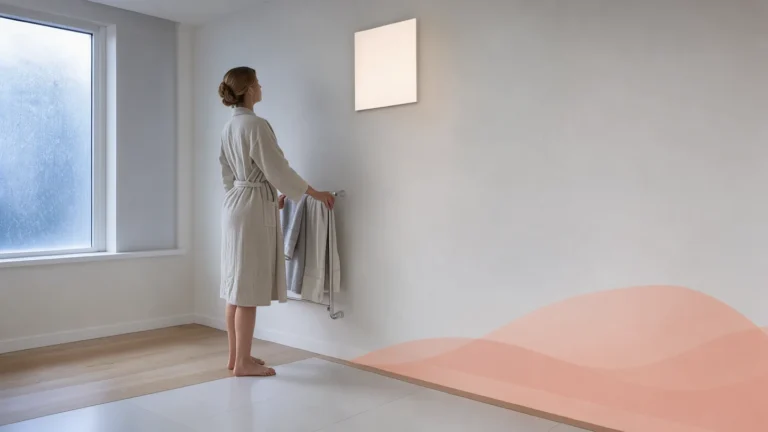
For a bathroom, you need a panel rated for damp or wet locations. The listing will state this explicitly, often with an IP rating (Ingress Protection). An IP44 rating means the enclosure resists splashing water from any direction. An IP65 rating means it resists low-pressure water jets. Check the spec sheet before mounting anything in a bathroom. A panel rated only for dry locations in a steamy room is an electrical hazard, not a heating solution.
Extension cords and circuit safety
A 1,500 W panel on a 120 V circuit draws 12.5 amps. A standard US bedroom or living room circuit is usually 15 amps, shared with other outlets and lights. If you already have a lamp, a phone charger and a small fan on that circuit, adding a 12.5 amp panel can trip the breaker or, worse, overheat the wiring if the circuit is old or undersized.
Never run a panel through an extension cord. Most consumer extension cords are rated for 10 to 15 amps, but they are designed for intermittent use, not continuous high-wattage loads. The cord can overheat inside its insulation, melt, and start a fire behind a bookshelf where you will not see it. Plug the panel directly into a wall outlet on a dedicated circuit, or have an electrician install a 240 V hardwired connection that draws half the amps for the same wattage.
Do this first
Safety checklist before you buy or install
Confirm the listing
Look for UL, ETL or CSA on the product page, the box or the panel itself. No listing means no independent safety test. Walk away.
Read the clearance spec
Find the minimum distance from walls, ceilings and combustibles. Measure your wall space before you buy. If your curtain or headboard falls inside that gap, the panel does not fit that room.
Check your circuit
Find the breaker that serves the outlet where you plan to plug in. Note whether it is 15 or 20 amps. Add up the wattage of everything else on that circuit. If the total exceeds 80 percent of the breaker rating (1,440 W on a 15 amp circuit), you need a different outlet or a hardwired install.
Verify the damp rating for bathrooms
If the room gets steamy, the panel must carry a damp or wet location rating. A dry-location panel in a bathroom is not safe, regardless of how well it heats.
Skip the extension cord
Plug directly into a wall outlet. If the cord that came with the panel is short, that is intentional. Do not extend it.
Common safety questions
Can an infrared panel start a fire?
A listed panel installed at the correct clearance will not start a fire under normal operation. The surface temperature is well below the ignition point of common household materials. The risk comes from ignoring clearances, covering the panel with fabric, or running it through an undersized extension cord.
Are infrared panels safe for babies and toddlers?
Yes, if mounted out of reach. A panel at 7 feet on a wall cannot be touched by a child. The surface temperature is lower than a quartz element, so even accidental contact is less likely to cause a serious burn. Avoid mounting panels at low heights in rooms where small children play.
Do infrared panels produce harmful radiation?
No. Infrared panels emit long-wave infrared radiation, the same type of energy your body radiates and the same type you feel as warmth from a sunbeam on your face. This is not ionizing radiation. It does not damage DNA or cause cancer. The panel is not a medical device and makes no health claims.
Can I leave an infrared panel on overnight?
Yes, if it has a thermostat or a timer and is installed at the correct clearance. A panel with no thermostat that runs continuously at full wattage all night is a waste of electricity and puts unnecessary heat into the room. Use a thermostat or a plug-in timer.
What happens if a panel gets wet?
A dry-location panel that gets wet can short circuit or trip a GFCI breaker. A damp-rated panel is designed to handle moisture. If water contacts a dry-rated panel, turn off the breaker before touching it and do not use it again until an electrician inspects it.
Are infrared panels safer than space heaters?
For fire risk and tip-over risk, yes. A wall-mounted panel cannot fall onto a carpet, and its surface is far cooler than an exposed quartz element. For electrical safety, the risk is similar: both draw high amperage and both need a proper circuit. The advantage is physical placement and surface temperature.