Are Infrared Heating Panels Worth It? Pros, Cons and Who They Suit
Here is the short answer: an infrared heating panel is worth it when you have one room that never gets warm enough and you use it daily. It is not worth it as a whole-house heating system, where a ductless mini split usually wins on efficiency.
If your basement office sits at 58°F while the rest of the house holds 70°F, a 600 W panel on the wall can bring that room to comfortable in about 30 minutes, run quietly, and add roughly $20 to your monthly electric bill. No fan, no dust, no floor space taken. That is the case for buying one.
But if you are hoping to heat your entire home with panels, or if you only need warmth for an hour a day in a small space, a cheaper option will serve you better. This article walks through the honest math, the rooms where panels shine, and the three situations where they do not.
Key takeaways
- Worth it for one cold room used daily; not worth it for whole-house heat where a heat pump wins on efficiency.
- A 600 W panel in a 12×12 room costs roughly $20 per month at 15 cents per kWh running 8 hours a day.
- Most panels under 1,500 W plug into a standard 120 V outlet; larger panels need a 240 V circuit and a licensed electrician.
- Panels heat people and surfaces directly, not the air, so they feel warm faster than baseboard but do not warm a room as fast as a fan-forced space heater.
- The wrong choice when you need whole-house heat, when a $30 space heater covers your need, or when your circuit cannot handle the extra load.
The verdict in plain terms
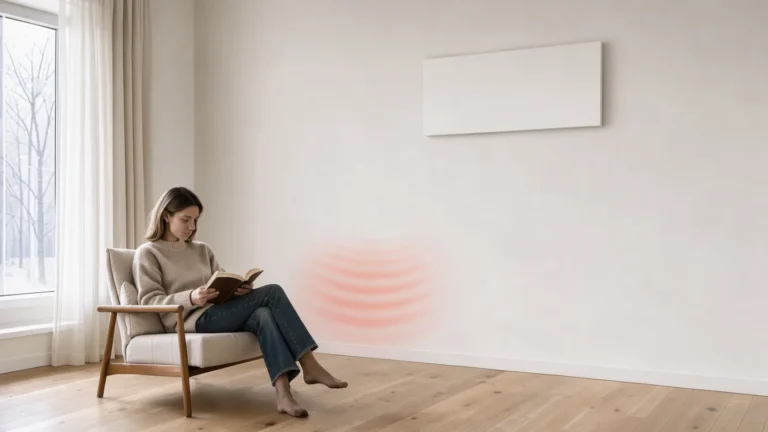
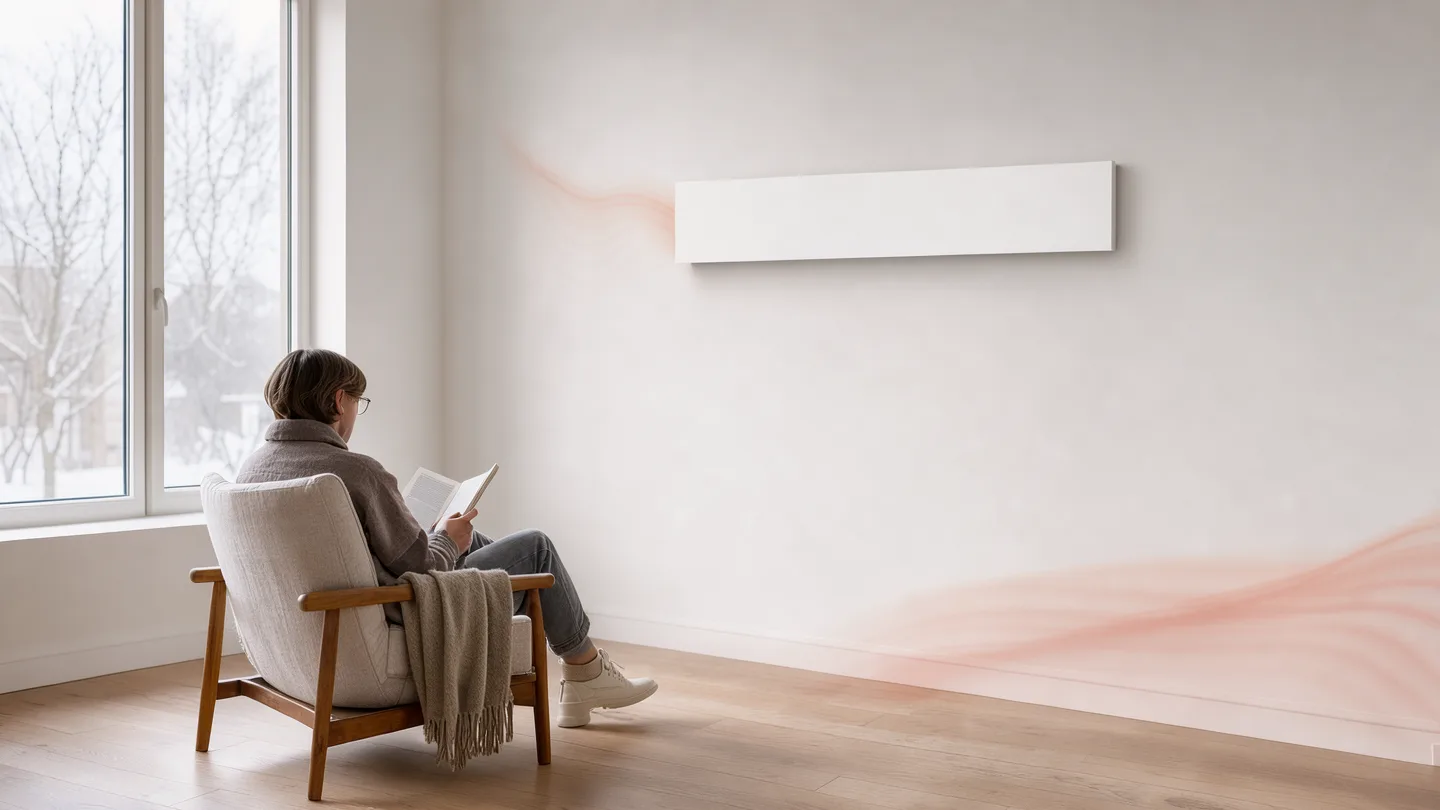
An infrared heating panel is a flat panel, usually 2 to 4 feet wide, that you mount on a wall or ceiling. It radiates infrared energy, the same kind of heat you feel from the sun on your face on a cold, still day. The panel itself stays warm to the touch, around 150 to 200°F on its surface, and it warms your skin, your clothes, and the furniture in front of it. The air in the room warms secondarily, the way a stone wall stays warm after sunset.
This is different from a space heater that blows hot air at you, and different from baseboard that slowly warms the air through convection. Infrared panels heat you directly. That means you feel warm within minutes even if the room air is still cool, and you can set the thermostat lower because your body is getting the heat it needs.
The honest verdict: if you have one room that is consistently cold and you spend hours in it each day, a panel is a good fit. If you want to heat your whole house, a ductless mini split (a heat pump that moves heat rather than creating it) will cost less to run over a full heating season. If you only need warmth for 30 to 60 minutes a day in a small space, a $30 space heater is simpler and cheaper upfront.
How many watts do you need?
The starting point is square footage and ceiling height. For a room with standard 8-foot ceilings and average insulation, a rough guide is 10 to 15 watts per square foot. A 12×12 room (144 square feet) needs about 1,400 to 2,100 watts for full heating. If the room is well insulated, you can lean toward the lower end. If it has a lot of glass, an exterior wall, or a concrete floor, lean toward the higher end.
For supplemental heat, meaning you are topping up a room that is already somewhat warm, you can use less. A 600 W panel in a 12×12 basement office that sits at 58°F will not bring the room to 72°F on its own, but it will make you feel comfortable at the desk because it is warming you directly. Many people find that 400 to 800 watts is enough for a single person at a desk or workbench.
Here is the arithmetic for a 600 W panel running 8 hours a day at a typical US residential rate of 15 cents per kWh:
600 watts × 8 hours = 4,800 watt-hours per day = 4.8 kWh per day 4.8 kWh × 30 days = 144 kWh per month 144 kWh × $0.15 = $21.60 per month
That is the number you can redo with your own rate. Check your electric bill for the cents-per-kWh figure in your area. Rates range from about 10 cents in parts of the Pacific Northwest to over 30 cents in Hawaii and parts of the Northeast.
Monthly running cost for your panel
Enter your panel wattage, daily hours, and your local electricity rate to see what a panel adds to your monthly bill.
Estimated monthly cost USD
Plug in or call an electrician?
Most infrared panels sold in the US are 120 V and plug into a standard wall outlet. A 600 W panel draws 5 amps (600 ÷ 120 = 5). A 1,500 W panel draws 12.5 amps. A standard 15-amp circuit can handle up to 1,800 watts total, but the safe continuous load is 80% of that, so 1,440 watts. If your circuit already has a lamp, a computer, and a space heater on it, adding a 1,500 W panel will trip the breaker.
Check your circuit before you buy. Find the breaker that serves the outlet in your cold room. If it is a 15-amp breaker, you have 1,440 watts of safe continuous capacity to share with everything else on that circuit. If it is a 20-amp breaker, you have 1,920 watts.
Panels above 1,500 W are usually 240 V and require a dedicated circuit installed by a licensed electrician. This adds $200 to $500 to your project cost depending on your panel and local rates. For most single-room applications, a 120 V panel under 1,500 W is the practical choice.

How panels compare to what you already know
You are probably judging a panel against a space heater, baseboard, or a mini split you have seen in a neighbor's house. Here is how they stack up on the factors that matter for one cold room.
| Factor | Infrared panel | Space heater | Electric baseboard | Ductless mini split |
|---|---|---|---|---|
| Heat type | Radiant, warms people and surfaces directly | Convection, blows warm air | Convection, warms air slowly | Moves heat from outside air indoors |
| Noise | Silent, no fan | Fan noise on most models | Silent | Outdoor unit hum, indoor fan |
| Dust movement | None, no air movement | Fan stirs dust | Minimal | Indoor fan moves some air |
| Floor space | Wall or ceiling mounted, zero floor space | Takes floor space, tip risk | Along baseboard, no floor space | Wall-mounted indoor unit |
| Warm-up speed | You feel warm in 5 to 10 minutes | Room warms in 15 to 30 minutes | Room warms in 30 to 60 minutes | Room warms in 10 to 20 minutes |
| Upfront cost | $150 to $500 for the panel | $30 to $100 | $50 to $150 per unit | $2,000 to $5,000 installed |
| Running cost | Same as any electric resistance heater | Same as any electric resistance heater | Same as any electric resistance heater | 2 to 4 times cheaper to run than resistance heat |
| Best for | One room, daily use, quiet and clean | Occasional use, small space, low budget | Whole-room background heat | Whole-house or multi-room heating |
| Wrong for | Whole-house heat, occasional use | Daily use in a large room | Rooms where you want instant warmth | Single-room supplemental heat |
The honest pros and cons
Infrared heating panels have clear strengths, but they are not a perfect fit for every home or every room. The panels heat objects and people directly rather than warming the air, which means you feel warmth almost immediately after switching them on. That makes them appealing for rooms you use in short bursts, like a home office or a bathroom.
On the downside, the warmth disappears quickly once you turn the panel off. There is no residual heat stored in the air the way a conventional radiator provides. If you want a room to stay warm for hours with minimal running cost, a panel alone may not be enough. You also need to think about placement. A panel mounted on a wall or ceiling only heats the area it faces, so poor positioning can leave parts of the room cold.
Where panels earn their keep
- Silent operation, no fan, no clicking, no humming
- No dust circulation, good for allergy-sensitive households
- Takes zero floor space, mounted on wall or ceiling
- You feel warm within minutes because heat is radiant, not convective
- Plug-in models need no electrician for rooms under 1,500 W
- Slim profile, about 1 inch thick, looks like a framed panel
- No combustion, no gas line, no venting, no carbon monoxide risk
- Can be taken with you if you rent and move
Where they fall short
- Same running cost as any electric resistance heater, no efficiency advantage
- Upfront cost is higher than a space heater for the same wattage
- Does not heat the whole room air quickly, you feel warm but the room may still feel cool
- Limited to one room per panel, not a whole-house solution
- Surface gets hot, 150 to 200°F, needs clearance from furniture and curtains
- A mini split costs 2 to 4 times less to run over a full heating season
- Larger panels need 240 V wiring and a licensed electrician
Three rooms where panels work well
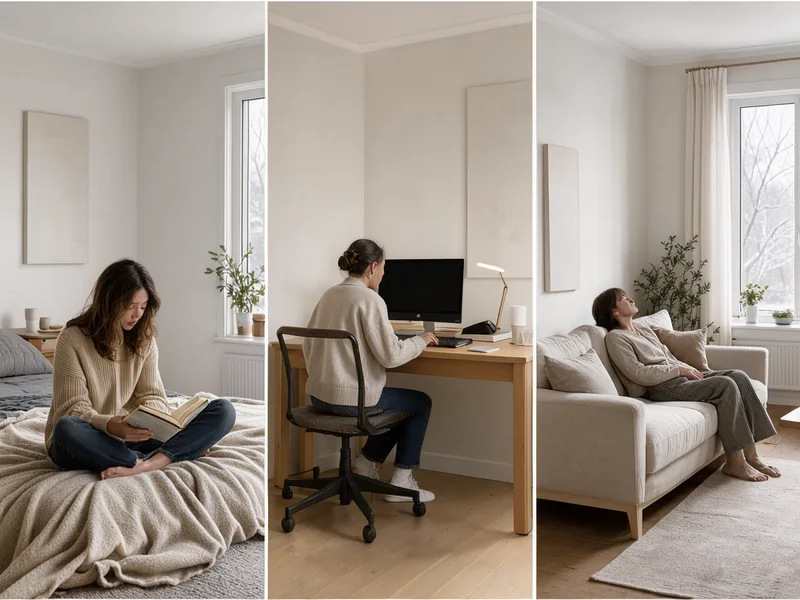
Not every room benefits equally from infrared panels. The best results come from spaces where you spend short periods of time and want instant warmth without heating the whole volume of air. Here are three rooms where panels tend to perform at their best.
A home office is a strong candidate. You sit in one spot for a few hours, and a panel mounted above or beside your desk keeps you comfortable without running the central heating for the whole house. A bathroom is another good fit. You need warmth quickly when you step out of the shower, and a panel can deliver that in seconds. Finally, a conservatory or sunroom often has poor insulation and high ceilings, making conventional heating expensive. A panel aimed at the seating area gives you targeted warmth without fighting the cold air above.
Rooms where an infrared panel fits
Basement home office
A finished basement office often sits 10 to 15 degrees cooler than the main floor because the concrete walls and floor pull heat away. A 600 to 800 W panel mounted on the wall behind or beside your desk warms you directly while you work. You feel comfortable at the desk even if the room air reads 62°F. Running 8 hours a day at 15 cents per kWh, that panel adds about $22 to your monthly bill. Mount it 4 to 6 feet high on the wall facing your seating area, with at least 6 inches of clearance from the ceiling and 12 inches from any furniture.
Cold-tile bathroom at 6 a.m.
A bathroom with tile floors and walls feels cold first thing in the morning because tile has high thermal mass and pulls heat from your bare feet. A 400 to 600 W panel mounted on the wall near the vanity or shower gives you radiant warmth the moment you step in. Because it is wall-mounted, it stays out of the splash zone and takes no floor space. Look for a panel rated for damp locations (IP44 or higher) if it will be near the shower. A 400 W panel running 1 hour a day costs about $1.80 per month at 15 cents per kWh.
Garage workshop
A detached or attached garage is hard to heat because it is poorly insulated and often has a large overhead door. A 1,000 to 1,500 W panel mounted on the wall above your workbench gives you radiant warmth while you work. You feel warm at the bench even if the garage air is 50°F. A 1,500 W panel on a 120 V circuit draws 12.5 amps, which fits on a dedicated 15-amp or 20-amp circuit. If your garage circuit is shared with other tools, check the total load before adding the panel. Running 4 hours a day at 15 cents per kWh, a 1,500 W panel costs about $27 per month.
When a panel is the wrong choice
A panel is not the right answer in three common situations.
First, if you want to heat your whole house or multiple rooms through winter, a ductless mini split is the better investment. A mini split moves heat from outside air into your home rather than creating it from electricity, so it delivers 2 to 4 units of heat for every unit of electricity consumed. Over a full heating season, that means a mini split costs roughly half to a quarter of what resistance heating costs. The upfront price is higher, but the running cost difference pays it back over several winters.
Second, if you only need warmth for 30 to 60 minutes a day in a small space, a $30 to $50 space heater does the job. A panel's advantages are quiet operation, no dust, and no floor space. If you do not care about those, a basic ceramic space heater is cheaper and simpler.
Third, if your electrical circuit cannot handle the extra load, do not force it. A 15-amp circuit shared with a refrigerator, a few lamps, and a computer has little headroom for a 1,500 W panel. Adding it will trip the breaker or, worse, overheat the wiring. In that case, either use a lower-wattage panel (400 to 600 W) or have an electrician add a dedicated circuit.
Common questions about infrared heating panels
Are infrared heating panels safe?
Yes, when they carry a UL, ETL, or CSA listing and you follow the clearance instructions. The surface gets hot, typically 150 to 200°F, so keep furniture, curtains, and anything flammable at least 12 inches away. They produce no combustion gases, no carbon monoxide, and no open flame. The infrared radiation they emit is the same kind of heat you feel from sunlight, not ionizing radiation.
Do infrared panels use less electricity than a space heater?
No. Both are electric resistance heaters, meaning they convert 100% of the electricity they draw into heat. A 1,500 W panel and a 1,500 W space heater use the same electricity and cost the same to run. The difference is how the heat reaches you: the panel radiates it directly to your body, so you feel warm at a lower air temperature and may set your thermostat lower.
Can I leave an infrared panel on all day?
Yes, if the panel has a built-in thermostat or you pair it with a plug-in thermostat. Most panels are designed for continuous operation. Just make sure the circuit can handle the load continuously (80% of breaker rating for continuous use) and that nothing combustible is within the clearance zone.
Do infrared panels work through walls or windows?
No. Infrared radiation travels in straight lines and is absorbed by solid surfaces. A panel heats what is in front of it. It will not warm an adjacent room through a wall, and it will not heat through a closed door. This is why placement matters: aim the panel at the area where you spend time.
Are infrared panels good for renters?
Yes, if you choose a plug-in 120 V model under 1,500 W. You can mount it with the included bracket, unplug it when you move, and take it with you. No electrician, no permanent wiring changes. Check your lease for any restrictions on wall mounting, and use removable mounting hardware if your landlord requires it.
How long do infrared panels last?
Most panels use a carbon fiber or metal alloy heating element rated for 25,000 to 50,000 hours of operation. At 8 hours a day, that is 8 to 17 years. There are no moving parts, no fan to wear out, and no filter to replace.
What to look for before you buy
Three things matter more than brand or price.
First, the listing. Only buy panels with a UL, ETL, or CSA certification mark. This means the panel has been tested for electrical safety and fire risk by an independent lab. Panels without a listing may be cheaper but carry real risk, especially if mounted near curtains or on a wall with hidden wiring.
Second, the wattage and voltage match your circuit. A 600 W panel on a 120 V circuit draws 5 amps. A 1,500 W panel draws 12.5 amps. Know your breaker size and what else is on that circuit before you buy.
Third, the clearance requirements. Every panel has a minimum distance from walls, ceilings, and combustible materials. These are printed on the panel and in the manual. Ignore them at your own risk. A panel mounted too close to a curtain can start a fire.