
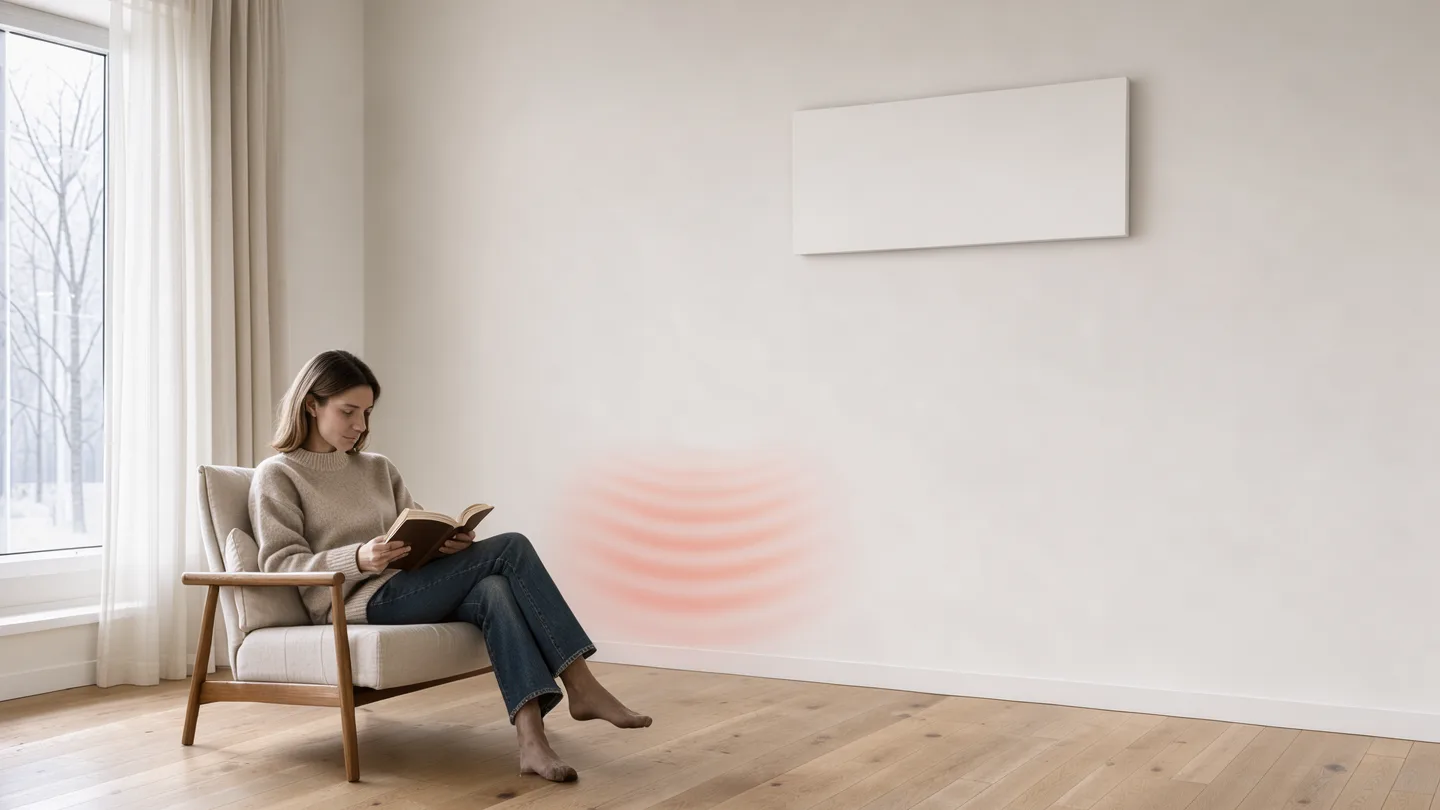
How Do Infrared Panel Heaters Work? Radiant Heat in Plain English
Stand outside on a cold, still January morning. The air reads 28 degrees Fahrenheit, but the sun hits your face and your cheeks feel warm within seconds. You are not warming the air between the sun and your skin. You are absorbing energy that traveled 93 million miles in a straight line and landed on you.
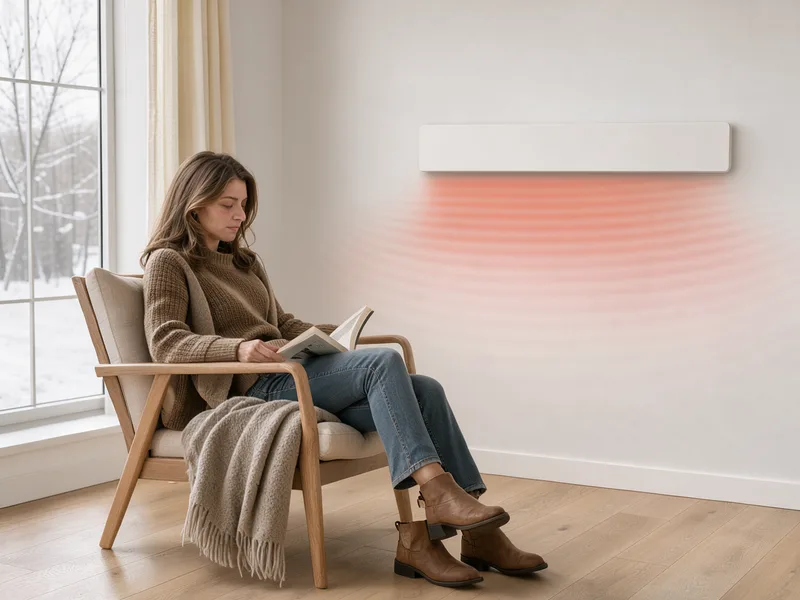
An infrared panel heater does the same thing on a small scale. It turns electricity into a beam of invisible light that warms your skin, your walls and your furniture before it warms the air. The room does not need to reach 72 degrees for you to feel comfortable. You feel warm because the radiation is landing on you, the way sunlight does.
This article walks through what is happening inside a flat panel, why the heat feels different from a space heater, and where the comparison with quartz heaters matters.
Key takeaways
- An infrared panel heater converts electricity into far-infrared radiation, a type of invisible light that travels in straight lines and warms surfaces it touches.
- The panel itself stays relatively cool, roughly 150 to 250 degrees Fahrenheit at the surface, which is why it feels gentle rather than like a blast of heat.
- You feel warm before the air temperature rises, because radiation heats your skin directly. A thermometer on the wall may still read 65 degrees while you feel comfortable.
- Flat panels differ from quartz heaters in surface temperature and wavelength. Quartz gets much hotter and feels more intense; flat panels spread warmth more evenly across a room.
- The air does eventually warm too, but as a secondary effect from warmed walls and furniture releasing heat, not from the panel heating the air directly.
You feel the sun before you feel the air
Think about that January morning again. The air around you is cold. Your skin is warm. The difference is that radiation does not need air to travel. It moves through empty space at the speed of light, about 186,000 miles per second. When it hits a surface, that surface absorbs the energy and its molecules start vibrating faster. Faster vibration means higher temperature.
This is radiant heat transfer. It is the same mechanism that warms your face from a campfire, your back from a tile stove, and your skin from the sun. The air in between is mostly transparent to this radiation, so it stays cool while the surfaces it hits get warm.
A convection heater, like a fan-forced space heater or an electric baseboard, works the opposite way. It heats the air touching it. That warm air rises, cooler air sinks to replace it, and a slow circulation loop builds up. The room warms from the air outward. You feel warm only after enough air around you has been heated.
What a flat panel actually does
Inside a typical infrared panel is a thin heating element. Depending on the model, that element might be a strip of carbon fiber, a layer of ceramic compound, or a metal alloy wire embedded in a flat substrate. When you plug the panel in and switch it on, electricity flows through that element and it heats up, the same way a toaster coil glows.
The element is bonded to a flat surface, usually aluminum or a mineral composite, that spreads the heat evenly across the panel face. That face then emits infrared radiation outward in a wide, gentle beam. The panel does not blow air. It does not have a fan. It simply radiates.
A typical consumer panel runs at a surface temperature of roughly 150 to 250 degrees Fahrenheit. That is hot enough to emit a useful amount of infrared energy but cool enough that you can touch the panel briefly without burning yourself, though you should still keep the clearance distances the manufacturer states.

Far-infrared: the part of the spectrum that warms your skin
Infrared radiation is a band of electromagnetic waves with wavelengths longer than visible red light. The full infrared range spans from about 0.7 micrometers to 1,000 micrometers. Within that range, engineers and physicists divide it into near, mid and far infrared.
Far-infrared sits roughly between 3 and 15 micrometers. A flat panel at 150 to 250 degrees Fahrenheit emits most of its energy in this band. That matters because far-infrared is absorbed readily by water molecules, and your skin is about 60 percent water. The radiation penetrates a fraction of a millimeter into the outer layer of your skin and is converted directly into warmth there.
This is why the sensation feels natural. It is the same wavelength range your own body emits. You are already a small infrared radiator. The panel is simply sending you more of the same kind of energy your body exchanges with its surroundings every moment.
Why the room feels warm even if the air stays cool
Here is the part that surprises most first-time users. You turn on a 400-watt panel in a 12 by 12 foot room. Within two or three minutes you feel warm where the radiation reaches you. But a wall thermometer still reads 64 degrees.
That is not a malfunction. The radiation is warming your skin, the wall opposite the panel, the desk, the bookshelf, the floor. Those surfaces are now warmer than they were. They in turn radiate some of that energy back into the room and also release a little heat into the air by convection. Over 20 to 40 minutes the air temperature does climb, but it climbs slowly and unevenly.
The practical result: you can set your thermostat lower and still feel comfortable, because your comfort depends more on the temperature of the surfaces around you than on the air temperature itself. Building scientists call this the mean radiant temperature, and it is the reason a room with cold walls feels chilly even when the air reads 70 degrees.
How this differs from a quartz heater
Quartz heaters are also radiant heaters, and people often confuse them with flat infrared panels. The difference is surface temperature and wavelength.
A quartz heater has a tungsten filament inside a clear or frosted quartz tube. That filament runs at 1,400 to 1,800 degrees Fahrenheit. At that temperature, most of the emitted energy falls in the near-infrared band, roughly 0.7 to 2.5 micrometers. Near-infrared carries more energy per photon and feels intense, almost like a hot blast on your face. It can be uncomfortable at close range and is why quartz heaters are common in garages, workshops and outdoor patios where you want a quick, directional hit of warmth.
A flat panel at 150 to 250 degrees Fahrenheit emits far-infrared instead. The energy is gentler, spreads over a wider angle, and does not sting your eyes or make the air feel dry. It is better suited to a room where you sit for hours: a home office, a reading corner, a bathroom.
| Heater type | How it transfers heat | What it warms first | Typical surface temp | Best for | Main drawback |
|---|---|---|---|---|---|
| Flat infrared panel | Far-infrared radiation | Skin, walls, furniture | 150 to 250 F | Sitting in one spot for hours, quiet rooms, allergy-sensitive homes | Slower to warm the whole room air; you must be in the radiation path |
| Quartz radiant heater | Near-infrared radiation | Skin directly, in a narrow beam | 1,400 to 1,800 F | Quick directional warmth, workshops, outdoor use | Intense and uncomfortable at close range; bright glow; short element life |
| Oil-filled radiator | Convection (heats air) | Air near the unit | 150 to 200 F | Even background warmth in a small room | Slow to start; moves dust; takes floor space |
| Fan-forced space heater | Convection (blows warm air) | Air in front of the unit | Element glows red, housing 150 to 250 F | Quick spot warmth for 30 to 60 minutes | Noisy; dries air; moves dust; high fire risk if tipped |
| Electric baseboard | Convection (natural rise) | Air along the wall | 150 to 250 F | Whole-room background heat in a well-insulated room | Slow response; heats air not people; hard to zone |
What you feel versus what a thermometer reads
A common question: if the panel is not heating the air, how do I know it is working?
You know because you feel warm. That is the point. But if you want a number, here is what to expect. A 400-watt panel aimed at you from six feet away delivers roughly 50 to 80 watts per square foot of your body surface in the radiation zone. Your skin absorbs most of that. You feel it within seconds because radiation travels at the speed of light.
A wall thermometer will lag. It measures air temperature, and the air is not the primary target. If you want to verify the panel is producing radiation, point an infrared thermometer gun at the panel face. You should read 150 to 250 degrees Fahrenheit depending on the model and its power setting.
When radiant heat is the right tool
Radiant heat works best when you are in the room and want to feel warm quickly without waiting for the air to turn over. It suits a basement office where you sit at a desk for four hours. It suits a bathroom where you want warmth the moment you step out of the shower. It suits a garage where you work at a bench and do not need to heat the entire volume of air.
It is the wrong tool when you want to warm a whole house evenly, when you need to heat air that is very cold and the room is drafty, or when you want to warm a space you will not occupy for the first hour. In those cases a heat pump, a baseboard system or a well-sized furnace does a better job.
Frequently asked questions
Do infrared panel heaters heat the air?
Not directly. They emit radiation that passes through the air without warming it. The air does warm eventually, but as a secondary effect: warmed walls, furniture and floor release some of their stored heat into the air by convection. This is why the room air temperature lags behind how warm you feel.
Is far-infrared the same as the infrared from a heat lamp?
No. A heat lamp or quartz heater runs at a much higher surface temperature and emits mostly near-infrared, which feels intense and directional. A flat panel runs at 150 to 250 degrees Fahrenheit and emits far-infrared, which feels gentle and spreads over a wider area. Both are radiant heat, but the wavelength and intensity differ.
Can I feel the difference between a panel and a space heater?
Yes. A space heater warms the air around it, so you feel warm only after the air has circulated to you. A panel sends radiation that reaches your skin in a fraction of a second. You feel warmth almost instantly in the direction the panel faces, even if the air behind you is still cool.
Do infrared panels dry out the air?
No. They do not heat the air, so they do not lower relative humidity the way a convection heater does. This is one reason people with dry skin or sinus irritation prefer them.
How long does it take to feel warm?
Within seconds to a minute, depending on distance and panel wattage. Radiation travels at the speed of light, so the delay is only the time it takes your skin to absorb enough energy to register warmth. Compare that to a convection heater, which may take 10 to 20 minutes to warm the air around you.
Does the panel need to be pointed at me?
It helps, but it is not strictly necessary. The panel radiates in a wide angle, typically 120 to 160 degrees. Walls and furniture in that arc absorb the radiation and re-radiate it, so the warmth spreads. Still, you will feel most comfortable when the panel faces the area where you sit or stand.