
Are Infrared Heaters More Energy Efficient? The Honest Math
You have probably seen the claim that infrared heating panels are "more energy efficient" than a space heater or baseboard. The honest answer is that they are not, at least not in the way most people mean it. Every electric resistance heater, including an infrared panel, converts close to 100 percent of the electricity it draws into heat. A 1,500 W panel and a 1,500 W space heater produce the same amount of heat energy. The difference is not in how much heat they make. It is in how that heat reaches you, and whether you can turn the rest of the house down.
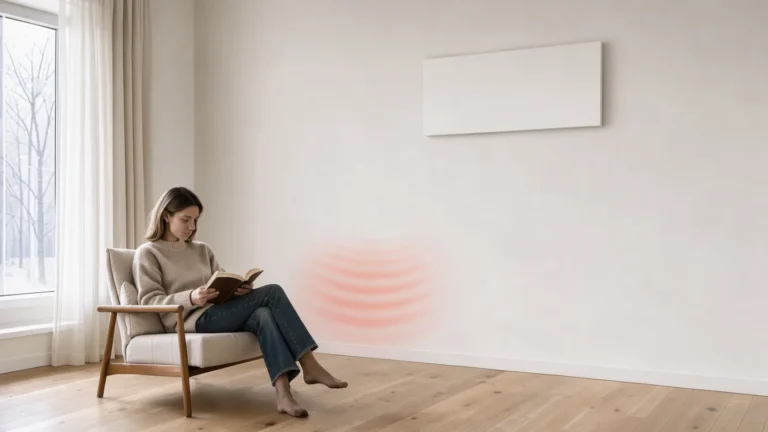
That second part is where real savings live. An infrared panel warms your skin and the surfaces in front of it, the way sun on your face warms you on a cold, still day. You feel comfortable at a lower air temperature than you would with a heater that only warms the air. And because a panel is quiet, wall-mounted and takes no floor space, it is easy to heat one room and leave the rest of the house cooler. That is zone heating, and it is where the monthly bill actually drops.
This article walks through the physics, the arithmetic and the named assumptions so you can redo the math with your own numbers. No magic numbers, no guaranteed savings, just the honest picture.
Contents
- Every electric heater is 100 percent efficient, and that is not the point
- The comfort-at-a-lower-temperature effect, with numbers
- Why a heat pump is genuinely more efficient
- When an infrared panel is the wrong choice
- The assumptions behind every number in this article
- Common questions about infrared heater energy efficiency
What you need to know
- Every electric resistance heater, including an infrared panel, converts roughly 100 percent of its wattage into heat. There is no efficiency gap between a panel and a space heater at the same wattage.
- Real savings come from two things: feeling comfortable at a lower air temperature, and heating only the room you are in instead of the whole house.
- A 600 W panel running 6 hours a day at 15 cents per kWh adds about $16 to your monthly bill. A 1,500 W space heater on the same schedule adds about $41.
- A ductless mini split heat pump moves more heat energy than the electricity it uses, so it is genuinely more efficient for whole-house or large-area heating.
- An infrared panel is the wrong choice when you need to heat a large open space, when your ceiling is very high, or when a heat pump already covers the room.
Every electric heater is 100 percent efficient, and that is not the point
Here is the fact that settles the debate: electric resistance heating converts close to 100 percent of the electrical energy it consumes into heat. This is not a marketing claim. It is basic physics. When current flows through a resistive element, the electrical energy becomes thermal energy. An infrared panel, a ceramic space heater, an oil-filled radiator and an electric baseboard all do this. They all turn a watt of electricity into roughly a watt of heat.
So when a product page says an infrared panel is "99 percent efficient" and a space heater is "80 percent efficient," that comparison is misleading. Both are converting nearly all their input power into heat. The difference is in the form that heat takes and how it reaches your body.
A convection heater (a space heater with a fan, or a baseboard) warms the air in the room. The warm air rises, mixes, and eventually transfers some of its energy to your skin by convection and a small amount by radiation. An infrared panel sends electromagnetic radiation (infrared wavelengths, the same part of the spectrum you feel as warmth from sunlight) directly at the surfaces and people in front of it. The air in between barely warms. You feel the heat on your skin the way you feel warmth from a campfire or from the sun on a cold day, even when the air around you is cool.
That difference in delivery method is what changes your comfort, and that is where the savings come from.

Where real savings come from with an infrared panel
Two mechanisms produce actual dollar savings, and neither depends on the panel being "more efficient" at converting watts to heat.
The first is comfort at a lower air temperature. Because infrared radiation warms your skin directly, you feel comfortable at a lower room air temperature than you would with a convection heater. Studies of radiant heating comfort (the kind done in building science labs) consistently show that people feel equally warm at an air temperature roughly 3 to 5 degrees F lower when radiant heat is present. If you set your thermostat 4 degrees lower in the room you occupy, your heating system (whether it is a furnace, a heat pump or baseboard) runs less. That is where the bill drops.
The second is zone heating. An infrared panel is small, quiet, wall-mounted and plug-in at 120 V for most models up to about 1,500 W. You can put one in a basement office, a bathroom or a garage workshop and heat only that room. If your central system is a furnace or a heat pump, you can lower the whole-house thermostat and let the panel handle the one room where you spend your time. You are not heating empty bedrooms, a hallway and a living room you are not using.
Neither of these savings comes from the panel being a more efficient converter of electricity. They come from using less total energy because you are heating less space and feeling comfortable at a lower temperature.
The comfort-at-a-lower-temperature effect, with numbers
Let us put a number on this so you can see the arithmetic.
Assume your home is heated by a gas furnace with a thermostat set to 70 degrees F. You spend most of your evening in a basement office that the furnace barely warms. You install a 600 W infrared panel on the wall facing your desk.
With the panel on, you feel comfortable at 66 degrees F in that room because the radiant heat warms your skin directly. You lower the whole-house thermostat from 70 to 66 degrees F. Your furnace now runs less because the temperature difference between inside and outside is smaller.
The savings depend on your climate, your insulation and your furnace efficiency, but a rough rule of thumb from building science is that each degree you lower the thermostat saves about 1 to 3 percent on your heating bill. Lowering it 4 degrees saves roughly 4 to 12 percent on your whole-house heating cost. If your winter heating bill is $200, that is $8 to $24 per month saved, minus the cost of running the panel.
The panel itself costs about $16 per month to run (600 W, 6 hours a day, 30 days, at 15 cents per kWh). So in this scenario you might save $8 to $24 on the furnace while spending $16 on the panel. The net could be a small saving, a wash, or a small extra cost depending on your climate and insulation. The honest answer is that the savings are modest and depend on your specific situation.

Zone heating: warming one room instead of the whole house
The bigger savings come from not heating rooms you are not using. If your central system is electric baseboard or a heat pump, and you spend 8 hours a day in one room, you can lower the whole-house thermostat and let a panel handle that room.
Say your whole-house electric heating costs $150 per month in January. You lower the thermostat by 5 degrees and add a 600 W panel in your office. The whole-house cost drops by roughly 10 to 15 percent (building science rule of thumb: 1 to 3 percent per degree). That is $15 to $22 saved. The panel costs $16 per month. Net saving: $0 to $6 per month.
Now say you have a gas furnace and your whole-house heating bill is $200 per month. You lower the thermostat 5 degrees and add the panel. The furnace saves $20 to $30. The panel costs $16. Net saving: $4 to $14 per month.
These are not dramatic numbers. The honest truth is that an infrared panel is not a magic bill-cutter. It is a tool that lets you heat one room cheaply and comfortably, and if you use it to lower your whole-house thermostat, you save a little. The real value is comfort: a warm office, a warm bathroom at 6 a.m., a warm garage workshop, without running the whole-house system for one person in one room.
| Option | Converts electricity to heat at | Typical watts for a 12×12 room | Monthly cost at 6 hrs/day, 15 cents/kWh | Best for |
|---|---|---|---|---|
| Infrared panel (plug-in) | Close to 100 percent | 400 to 800 W | $11 to $22 | One room, quiet, wall-mounted, no floor space |
| Ceramic space heater (fan) | Close to 100 percent | 1,500 W | $41 | Quick spot heat, portable, noisy |
| Oil-filled radiator | Close to 100 percent | 1,500 W | $41 | Slow steady heat, no fan, takes floor space |
| Electric baseboard | Close to 100 percent | 1,000 to 2,000 W | $27 to $54 | Whole-room heat, permanent install |
| Ductless mini split (heat pump) | 200 to 350 percent (moves heat) | 1,000 to 1,500 W input | $9 to $14 | Large rooms, whole-house, cold climates |
Why a heat pump is genuinely more efficient
A ductless mini split heat pump is not an electric resistance heater. It moves heat from outside air into your room using a refrigeration cycle. For every watt of electricity it consumes, it delivers 2 to 3.5 watts of heat energy into the room. This is measured as a coefficient of performance (COP). A COP of 3 means 1 watt of electricity produces 3 watts of heat.
That is a real efficiency advantage that an infrared panel cannot match. A panel is capped at 1 watt of heat per watt of electricity. A heat pump can deliver 2 to 3.5 watts of heat per watt of electricity because it is moving existing heat rather than creating it.
So if you need to heat a large room, a whole floor, or your entire house, a heat pump is the more efficient choice. An infrared panel is not competing with a heat pump on efficiency. It is competing with a space heater, a baseboard or an oil-filled radiator on comfort, convenience and room-level control.
When an infrared panel is the wrong choice
Be honest with yourself about these situations:
You need to heat a large open space. A 600 W panel will not warm a 400 square foot garage with 10-foot ceilings. You need more watts, and at that point a heat pump or a forced-air system makes more sense.
Your ceiling is very high. Infrared radiation travels in straight lines. If your ceiling is 12 feet high and you mount the panel at 8 feet, the radiation spreads over a larger area and the intensity at your skin drops. You need more watts to compensate, and the comfort advantage shrinks.
You are heating the whole house. A heat pump or a high-efficiency furnace will beat a collection of panels on total energy cost. Panels are a room-level tool, not a whole-house strategy.
You only need heat for 30 minutes. A cheap 1,500 W space heater that you plug in, run for 30 minutes and unplug is simpler and costs about $0.11 per use. A panel is better when you want quiet, continuous, wall-mounted heat for hours at a time.
Your circuit is already loaded. A 120 V circuit in a US home is typically rated at 15 amps, which is 1,800 watts at 120 V. If you already have a space heater, a microwave or a hair dryer on that circuit, adding a 1,500 W panel will trip the breaker. Check your circuit before you buy.
Monthly running cost for an infrared panel
Enter your panel wattage, how many hours per day you run it, how many days per month, and your electricity rate. The formula is: watts times hours per day times days per month, divided by 1000, times cents per kWh, divided by 100.
Estimated monthly cost USD
The assumptions behind every number in this article
Every figure above rests on named assumptions. Here they are, so you can swap in your own.
Electricity rate: 15 cents per kWh. The US average residential rate has been around 16 to 17 cents per kWh in recent years, but rates vary widely by state and utility. Check your bill. If your rate is 22 cents, multiply every cost figure here by 1.47.
Panel wattage: 600 W for a typical 12×12 room with 8-foot ceilings and average insulation. A poorly insulated room or a room with a lot of glass may need 800 to 1,000 W. A well-insulated small room may need only 400 W.
Hours per day: 6 hours. This is a typical workday or evening usage. If you run it 10 hours, multiply the cost by 1.67.
Thermostat reduction: 4 to 5 degrees F. This is the comfort-at-a-lower-temperature effect. If you do not lower your whole-house thermostat, the panel adds cost without offsetting anything.
Furnace or heat pump savings: 1 to 3 percent per degree of thermostat reduction. This is a widely cited building science rule of thumb. Your actual savings depend on your climate zone, insulation quality, window area and system efficiency.
Common questions about infrared heater energy efficiency
Are infrared heaters more energy efficient than space heaters?
No. Both convert close to 100 percent of their electrical input into heat. A 1,500 W infrared panel and a 1,500 W space heater produce the same amount of heat energy. The difference is in how that heat reaches you and whether you can use it to lower your whole-house thermostat.
Do infrared heaters use less electricity than space heaters?
Not at the same wattage. A 600 W panel uses the same electricity as a 600 W space heater. But you may need fewer watts from a panel to feel comfortable in the same room, because radiant heat warms your skin directly. A 600 W panel may feel as warm as a 1,000 W convection heater on your skin.
Can I save money by switching from a space heater to an infrared panel?
Only if you use the panel to lower your whole-house thermostat, or if you need fewer watts to feel comfortable. If you simply swap one 1,500 W heater for another 1,500 W heater, your bill will not change.
Is a heat pump more efficient than an infrared panel?
Yes, for heating large areas. A heat pump delivers 2 to 3.5 watts of heat per watt of electricity because it moves heat rather than creating it. A panel is capped at 1 watt of heat per watt of electricity. For one small room, the panel's convenience and comfort advantage may outweigh the heat pump's efficiency advantage.
What is the real monthly cost of running an infrared panel?
A 600 W panel running 6 hours a day at 15 cents per kWh costs about $16 per month. A 1,500 W panel on the same schedule costs about $41 per month. Use the calculator above with your own numbers.
Does an infrared panel heat the air or the people?
It heats the people and surfaces in front of it. The air in between barely warms. This is the same mechanism as sunlight warming your face on a cold day. You feel warm even when the air temperature is low.