Infrared Bathroom Heater: Warm Tile at 6 a.m. Without a Fan
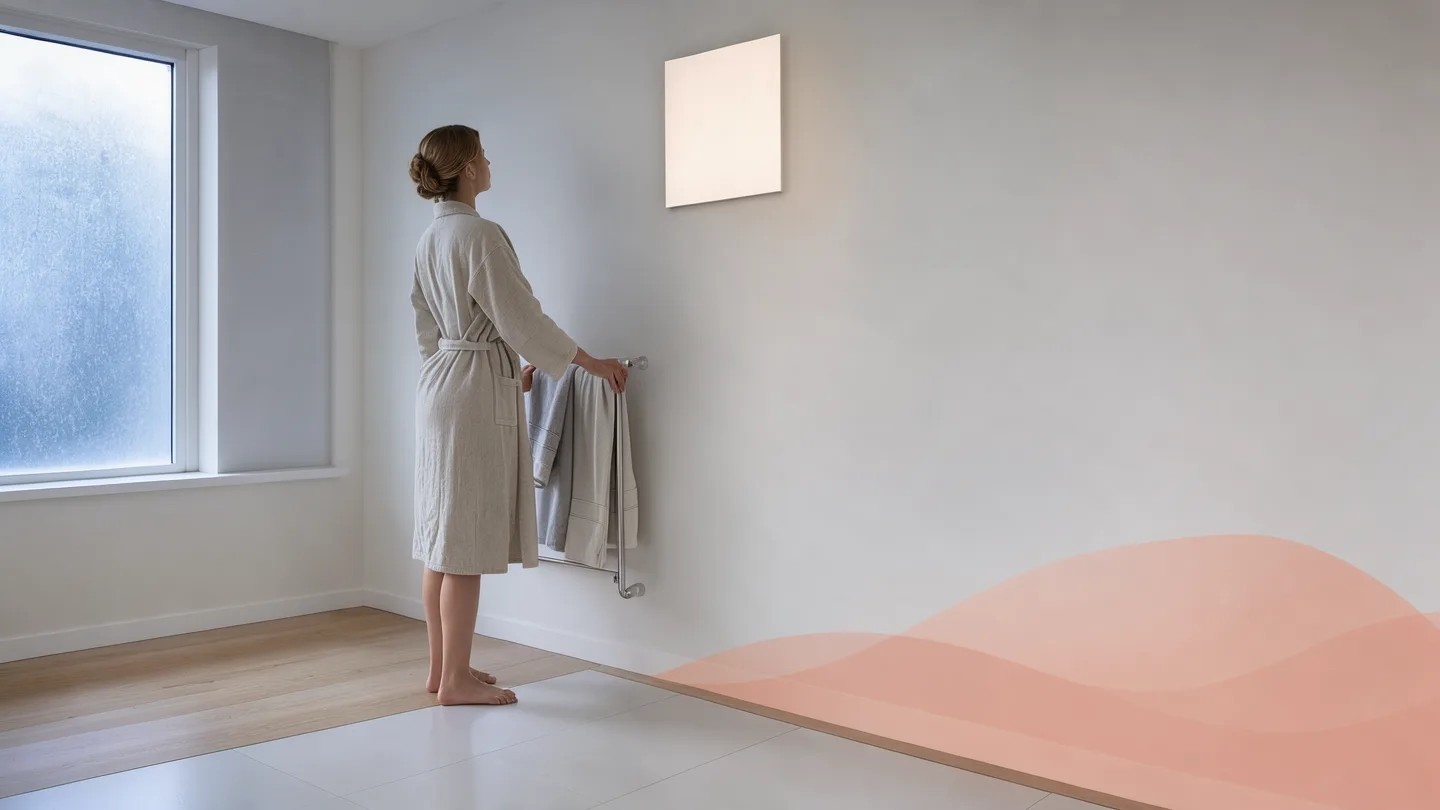
You step onto cold tile at 6 a.m. and your feet tell you the whole room is cold. The baseboard has been off all night. A space heater would blow dust around and take up floor space you do not have. An infrared panel mounted on the wall or ceiling warms your skin the way morning sun does, quietly, with no fan and no floor footprint.
But a bathroom is not a living room. It has standing water, high humidity, tile that holds cold, and electrical code rules that do not apply elsewhere. This guide walks through what to look for, how to size the panel, where to mount it, and what it costs to run on a timer.
At a glance
- Only use a panel listed for damp or wet locations, and only on a GFCI-protected circuit.
- Keep the panel at least the distance from tub or shower that the manufacturer's manual states, often 3 to 6 feet.
- A typical 5 by 8 foot bathroom needs roughly 400 to 600 watts of panel output for comfortable supplemental heat.
- A 600 W panel on a timer for 90 minutes a day adds about $4 to $5 per month at 15 cents per kWh.
- Ceiling mount gives the most even warmth on skin. Wall mount is easier to install and easier to aim.
- Pair the panel with a timer or smart switch so it runs before you enter, not after.
Why a bathroom is a different problem
A bathroom loses heat fast. Tile floors and walls conduct heat away from your feet and ankles. The room is small, so it heats up quickly, but it also cools quickly once the heat source stops. The ceiling is often 8 feet or higher, and the air near the floor stays cold because warm air rises and pools up there.
A fan-forced heater fights this poorly. It pushes warm air up, where it does you no good while you are standing on the tile. An infrared panel works differently. It sends infrared radiation, the same kind of energy you feel from sunlight on your face, directly onto your skin and the surfaces in front of it. Your body warms even if the air around you is still cool. That is why a panel can feel comfortable at a lower air temperature than a convection heater.
The other advantage is silence and cleanliness. No fan means no dust circulation, which matters in a small enclosed room where you breathe close to the source. No moving parts means nothing to rattle at 6 a.m.
Safety first: damp location listing, GFCI and clearance
This is the part you cannot skip. The National Electrical Code (NEC) requires GFCI protection for all bathroom receptacles and lighting circuits. GFCI stands for ground fault circuit interrupter. It is a device that cuts power in milliseconds if it detects current leaking through a person or a wet surface. Every bathroom circuit in a US home built after 1975 should already have GFCI protection at the outlet or the breaker.
Your infrared panel must carry a listing for damp locations at minimum. Look for the words "damp location" or "wet location" on the panel's label or in its spec sheet, alongside a UL, ETL or CSA mark. A panel rated only for dry locations is not approved for a bathroom, even if it seems to work fine. Moisture can reach the internal wiring over time and create a shock hazard.
Wet location listing is stricter. It means the panel is sealed against direct water spray. You need this rating if the panel will be mounted within the shower enclosure or directly above a bathtub where splashing is likely. For most bathroom installations outside the tub or shower zone, damp location is sufficient.
The manufacturer's manual will state a minimum distance from the edge of the tub, shower or sink. This is often 3 to 6 feet, but it varies by model. Measure it before you buy. If your bathroom is too small to meet that clearance, the panel is the wrong product for that room.
Ceiling or wall: which mounting suits your bathroom
Both work. The choice depends on your ceiling height, where the cold spot is, and whether you want to run wiring through the ceiling or along a wall.
| Factor | Ceiling mount | Wall mount |
|---|---|---|
| Heat feel | Even warmth on shoulders, head and floor surface | Directional warmth aimed at the spot you stand |
| Best for | Tall ceilings, rooms where you want uniform warmth | Small rooms, targeting the vanity or the tub edge |
| Installation | Hardwired to a ceiling junction box, usually 240 V | Plug-in 120 V or hardwired to a wall box |
| Clearance from water | Must still meet the manual's distance from shower or tub | Same rule, but easier to keep away from splash zones |
| Aesthetic | Flush and invisible from eye level | Visible panel, can be framed or painted |
| Typical wattage | 600 to 1200 W on a 240 V circuit | 300 to 600 W on a 120 V plug-in |
How many watts for your bathroom
There is no single magic number, but here is a method you can redo with your own measurements.
Start with the floor area. A small half bath might be 4 by 6 feet, so 24 square feet. A standard full bath is often 5 by 8 feet, so 40 square feet. A master bath with a tub, double vanity and a separate shower can be 80 to 120 square feet.
For supplemental heat in a well-insulated room with 8-foot ceilings, a rough starting point is 10 to 15 watts per square foot. A bathroom with tile floors and walls sits at the higher end because tile pulls heat from your body faster than carpet or wood.
Work through the arithmetic. A 5 by 8 foot bathroom is 40 square feet. At 12 watts per square foot, that is 480 watts. Round up to the nearest available panel size, so a 500 or 600 watt panel. A 10 by 12 foot master bath is 120 square feet. At 12 watts per square foot, that is 1,440 watts. You might use two 600 watt panels or one 1,200 watt panel on a 240 V circuit.
If your ceiling is 9 or 10 feet, add roughly 10 percent to the wattage. If the bathroom has a large exterior window with single-pane glass, add another 10 to 15 percent. These are adjustments, not fixed rules. The point is that you can do the math yourself and check whether a panel's rated output covers your room.
Timers and scheduling
A panel that runs all day wastes money. A panel that is off when you walk in feels pointless. The fix is a timer or a smart switch that turns the panel on 20 to 40 minutes before you typically enter the room.
For a 600 watt panel on a 120 V circuit, you can plug it into a plug-in timer that sits between the panel and the GFCI outlet. For a hardwired 240 V panel, you install a line-voltage timer or a smart relay in the junction box. A licensed electrician can do this in under an hour.
Set the timer to run for 30 to 60 minutes in the morning and 30 to 60 minutes in the evening. That is roughly 1 to 2 hours of run time per day. The panel warms your skin and the tile surface during that window. Once you leave, the room cools, but the next scheduled run catches it before you return.
Monthly running cost for your bathroom panel
Enter your panel wattage, daily run time and local electricity rate to see what the panel adds to your bill.
Estimated monthly cost USD
A typical setup for a 5 by 8 foot bathroom
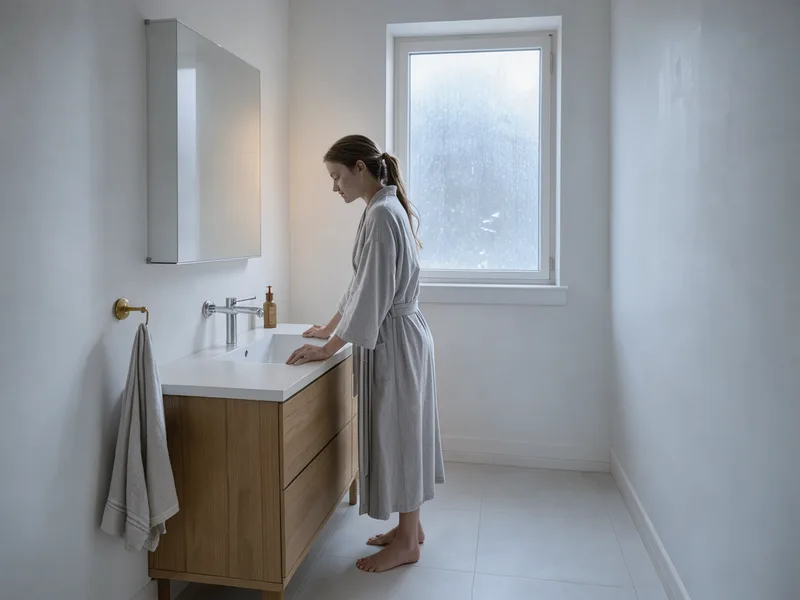
Here is what a common installation looks like. The room is 5 feet wide, 8 feet long, with an 8-foot ceiling, tile floor, a tub along one wall and a vanity on the opposite wall. The homeowner wants warmth at the vanity in the morning and at the tub in the evening.
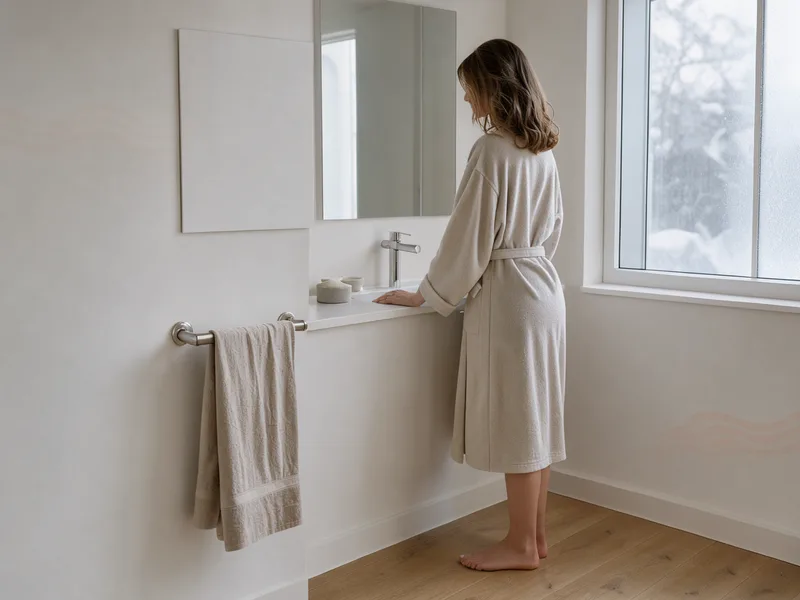
One 600 watt damp-location panel, 120 V plug-in, mounted on the wall above the vanity at about 7 feet high. It plugs into the existing GFCI outlet behind the vanity mirror. A plug-in timer turns it on at 5:40 a.m. for 40 minutes and again at 9:00 p.m. for 60 minutes. Total daily run time is 1 hour 40 minutes. At 15 cents per kWh, that is about 4 dollars and 20 cents per month.
No electrician is needed because the panel plugs into an existing GFCI outlet and the circuit already has GFCI protection. The panel sits about 4 feet from the edge of the tub, which meets the 3-foot minimum stated in the manual.
When a panel is the wrong choice for your bathroom
A panel is not always the answer. If your bathroom is very small, say 3 by 5 feet, and you only need warmth for 10 minutes while you brush your teeth, a small 300 watt plug-in panel or even a towel warmer may be enough. A 600 watt panel in that space would overheat the room quickly and cycle on and off.
If your bathroom has a window unit air conditioner or a ceiling fan that you run year-round, the moving air will reduce the comfort benefit of radiant heat. In that case, fixing the draft or adding a small convection heater may be simpler.
If you are trying to heat the entire bathroom from cold to 70 degrees F in under five minutes, a panel will not do that. Panels warm skin and surfaces, not air. A fan-forced heater or a mini split heats the air faster. A panel is best when you want to feel warm without waiting for the whole room's air to change temperature.
Common questions about infrared bathroom heaters
Can I install an infrared panel myself in a bathroom?
If the panel is a 120 V plug-in model and your bathroom already has a GFCI outlet, yes. You mount the panel on the wall with the included brackets, plug it in, and set a timer. If the panel is 240 V hardwired, or if you need a new circuit, hire a licensed electrician. The NEC requires that bathroom wiring meet specific rules, and a permit may be needed depending on your municipality.
What does "damp location" mean on a panel listing?
It means the panel's housing and internal components are rated to withstand the humidity and occasional moisture splashes found in a bathroom, without direct water spray. A damp-location panel is safe outside the shower or tub zone. A wet-location panel is sealed against direct spray and can go inside a shower enclosure if the manual allows it.
How far from the tub or shower should the panel be?
Check the manufacturer's manual. Most damp-location panels require at least 3 feet from the edge of a tub or shower. Some require 6 feet. This distance keeps the panel outside the splash zone defined by the NEC. If your bathroom is too small to meet the clearance, do not install the panel there.
Will a panel dry out my bathroom or reduce mold?
No. A panel does not reduce humidity. It warms surfaces, which can slightly reduce condensation on cold tile, but it is not a dehumidifier. If you have a moisture problem, use an exhaust fan rated for the room's square footage.
Can I use a panel in a bathroom with a shower over the tub?
Yes, as long as the panel is damp-location listed, on a GFCI circuit, and mounted at the clearance the manual specifies from the tub or shower edge. Many people mount the panel on the wall opposite the tub, which keeps it well outside the splash zone.
Do infrared panels in a bathroom create a fire risk with towels?
Keep towels at least the distance stated in the manual from the panel surface. Most panels have a surface temperature between 140 and 200 degrees F. A towel draped over the panel can overheat and scorch. Install the panel high on the wall or on the ceiling, away from where towels hang.