
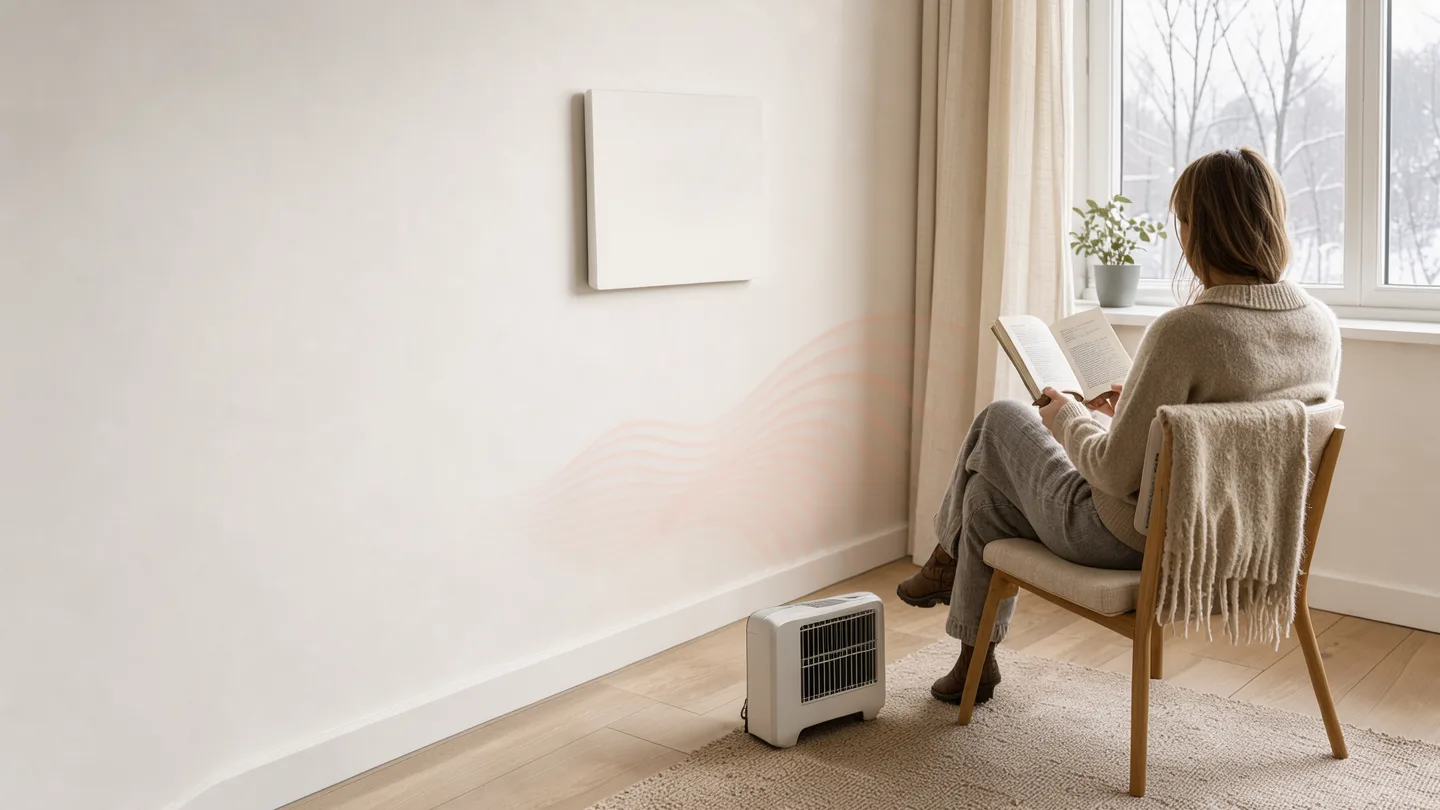
Infrared Panel Heater vs Space Heater: Which Should You Buy?
You have one room that never gets warm enough. Maybe it is a basement office where your feet go cold by 10 a.m., or a tiled bathroom that feels like a walk-in freezer at 6 a.m. You already know a space heater works. It is cheap, it plugs in, and it blows warm air at you within minutes. So why would you consider a flat panel that mounts on the wall and costs more up front?
The short answer: they heat differently. A space heater warms the air in the room. An infrared panel warms the surfaces and people in the room, the way the sun warms your face on a cold, still day. That difference changes how the room feels, how much it costs to run, and whether the heat stays put when you open the door.
This article puts them side by side on the things that matter: upfront cost, running cost per hour, noise, dust, warm-up time, floor space and best use. Then it tells you plainly when to pick each one, and when neither is the right answer.
What you need to know before you buy
- A space heater warms the air; an infrared panel warms people and surfaces directly, like sunlight on your face.
- A 1,500 W space heater costs about 23 cents per hour at 15 cents per kWh. A 600 W panel costs about 9 cents per hour at the same rate.
- Panels are silent and move no dust. Fan-forced space heaters do both.
- Panels take zero floor space because they mount on the wall. Space heaters sit on the floor and can be a trip or burn hazard.
- A space heater is the better choice if you need heat for one hour a day, if you rent and want the cheapest option, or if the room is drafty and poorly insulated.
- A panel is the better choice if you spend hours in the room, want quiet heat, have allergies, or need the floor clear.
How each one actually heats you
A space heater works by convection. It warms the air touching its heating element, that warm air rises, cooler air sinks to replace it, and a cycle begins. In a fan-forced model, a small fan pushes the warm air outward so the cycle moves faster. Either way, the heater is warming the air between you and the unit.
A far-infrared panel works by radiation. It emits long-wave infrared energy that travels in straight lines until it hits a surface: your skin, your desk, the floor, the wall opposite it. Those surfaces absorb the energy and warm up. You feel it the way you feel warmth from the sun on a cold winter day, even when the air around you is still cold. The air itself barely changes temperature until the warmed surfaces release their heat back into it.
This is why a panel can feel comfortable at a lower air temperature than a space heater. Your body loses heat to cold surfaces (walls, windows, floors) as much as it loses heat to cold air. A panel counteracts that surface heat loss directly. A space heater only counteracts it indirectly, by raising the air temperature until the surfaces stop pulling heat from you.
The side-by-side comparison
Here is how the two compare on the factors that matter most for a single cold room. The running cost column uses 15 cents per kWh, a common US residential rate. Swap in your own rate using the calculator below.
| Factor | Infrared panel (600 W) | Space heater (1,500 W) |
|---|---|---|
| Upfront cost | $150 to $400 for a UL-listed panel | $30 to $150 for a basic fan-forced unit |
| Running cost per hour at 15¢/kWh | About 9 cents | About 23 cents |
| Noise | Silent, no moving parts | Fan hum or click, 30 to 50 dB typical |
| Dust movement | None, no airflow | Fan circulates dust and allergens |
| Warm-up to comfort | 10 to 20 minutes on your skin and nearby surfaces | 2 to 5 minutes on the air directly in front of it |
| Floor space | Zero, mounts on the wall | Takes 1 to 2 square feet on the floor |
| Best use | Hours of seated work, sleeping, bathing, or any room where you want quiet, even warmth | Short bursts of heat, spot warming, or a room you use briefly |

What it costs to run, with the math shown
The formula is simple: watts divided by 1,000 gives you kilowatts. Multiply by hours used per day. Multiply by your electricity rate in dollars per kWh. That gives you the daily cost. Multiply by 30 for a monthly estimate.
For a 1,500 W space heater running 4 hours a day at 15 cents per kWh: 1,500 / 1,000 = 1.5 kW. Then 1.5 × 4 = 6 kWh per day. Then 6 × $0.15 = $0.90 per day. Then $0.90 × 30 = $27 per month.
For a 600 W panel running the same 4 hours a day at the same rate: 600 / 1,000 = 0.6 kW. Then 0.6 × 4 = 2.4 kWh per day. Then 2.4 × $0.15 = $0.36 per day. Then $0.36 × 30 = $10.80 per month.
The panel costs less to run because it uses fewer watts to achieve the same comfort level. You do not need to heat all the air in the room to feel warm when the panel is warming you directly.
Monthly running cost calculator
Enter your panel or heater wattage, how many hours per day you run it, and your electricity rate. The result is your estimated monthly cost.
Estimated monthly cost $
Choose the panel if
You spend three or more hours a day in the room. The panel's lower wattage saves you money over time, and the silent operation means no fan noise during calls, reading or sleep. You have allergies or asthma and want heat that does not stir up dust. You want the floor clear for a desk, a crib, a workshop bench or a yoga mat. The room has decent insulation and a ceiling at or below 9 feet, so the radiant heat stays where you put it.
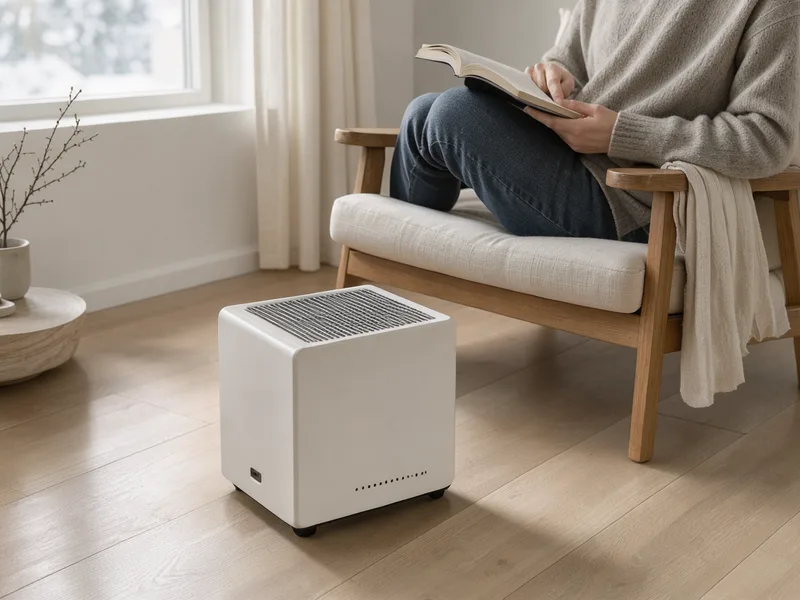
Choose the space heater if
You need heat for less than an hour a day, like warming a bathroom before a shower or taking the chill off a garage for a quick project. You rent and want the cheapest option you can unplug and carry to your next place. The room is drafty, poorly insulated, or has a high ceiling where radiant heat would be lost before it reaches you. You want instant warmth on your hands and face the moment you walk in, and you do not mind the fan noise.
When neither is the right answer
If you are trying to heat an entire house or a large open area, neither a single panel nor a single space heater will do it well. A ductless mini split heat pump moves three to four times more heat energy than the electricity it uses, so it costs far less per BTU than any resistance heater, panel or space heater included. If your cold room is part of a larger heating problem, a mini split is usually the better long-term investment.
If the room is tiny and you only need warmth for 20 minutes, a $40 ceramic space heater is honest and sufficient. There is no reason to mount a $300 panel for a 20-minute morning warm-up.
If your circuit is old and already loaded near its limit, adding any 1,500 W device can trip the breaker. Check your panel for the circuit rating (15 amps at 120 volts means 1,800 watts total for everything on that circuit) before plugging in a space heater or a hardwired panel.
Common questions about panels versus space heaters
Can I plug in an infrared panel like a space heater?
Yes, if the panel is rated for 120 volts and comes with a standard plug. Many panels under 1,500 W are plug-in. Larger panels or multiple panels on one circuit may need a 240-volt hardwired connection done by a licensed electrician. Check the panel's wattage and your circuit's amp rating before you plug in.
Do infrared panels use less electricity than space heaters?
They use less electricity for the same comfort level in a well-insulated room, because they heat you directly rather than heating all the air in the room first. A 600 W panel can feel as warm as a 1,500 W space heater on your skin. In a drafty or poorly insulated room, the advantage shrinks because the warmed surfaces lose heat to cold air quickly.
Are infrared panels safe to leave on overnight?
A UL or ETL listed panel with a built-in thermostat and tip-over or overheat protection is designed for continuous use. Keep the manufacturer's clearance distances (usually 3 to 6 inches from the wall and 12 to 24 inches from furniture) and do not cover the panel. A space heater with a fan is also safe overnight if it has tip-over and overheat shutoff, but the fan noise may disturb sleep.
Which is better for a basement office?
A panel is usually better for a basement office because you sit there for hours, you want silence during calls, and the floor needs to stay clear for a desk and chair. A space heater works if you only use the basement for an hour or two and want the lowest upfront cost.
Do infrared panels dry out the air like space heaters?
No. Neither type adds or removes moisture from the air, but a fan-forced space heater can make the air feel drier because it moves air across your skin faster, increasing evaporation. A panel does not move air, so it does not create that effect.