Best Heater for a Basement: Infrared Panel Setup Guide
You finished the basement last spring. New drywall, new carpet, a desk by the window. But in January the thermostat reads 61°F down there while the main floor sits at 70. The furnace runs, the ducts push warm air up, and the basement stays cold. You have tried a 1,500 W space heater. It works, but it takes floor space, the fan kicks dust around, and you trip over the cord every time you walk to the laundry.
An infrared heating panel is a different answer. It is a flat panel, usually 2 to 4 feet wide, that you mount on the wall or ceiling. It heats the people and surfaces in the room the way the sun heats your face on a cold, still day. No fan, no dust, no floor space. In this guide I will walk you through sizing, placement, wiring and monthly cost for a typical US basement, and I will tell you plainly when a panel is not the right tool.
At a glance
- A finished basement with 8-foot ceilings and average insulation typically needs 10 to 15 watts per square foot of floor area for supplemental heat.
- A 12 by 12 foot basement office (144 sq ft) at 12 W/sq ft needs about 1,700 W, which fits one 1,500 W plug-in panel plus a small 400 W panel, or one 2,000 W hardwired panel.
- Running a 1,500 W panel for 6 hours a day at 15 cents per kWh adds about $40.50 to your monthly electric bill.
- Most basements can take a plug-in 120 V panel on a dedicated circuit. A 240 V hardwired panel needs a licensed electrician and a double-pole breaker.
- A panel is the wrong choice if you need to heat the whole basement quickly, if the ceiling is under 7 feet, or if the room is damp enough to need a dehumidifier first.
Why basements stay cold
Basements are below grade, which means three walls and the floor are in direct contact with earth. In most of the US, that earth sits between 45 and 55°F in winter. Concrete and block walls conduct that cold straight into the room. Even a finished basement with R-13 batt insulation in the stud cavities loses heat through the slab and through any uninsulated rim joist at the top of the wall.
Low ceilings make it worse. A typical finished basement has 7-foot-6-inch to 8-foot ceilings, sometimes less under a dropped soffit for ductwork. Warm air from a forced-air system rises and pools near the ceiling, so the floor stays cold and your feet feel it. A space heater with a fan pushes that stratified air around, but it does not warm your body directly.
Moisture is the third factor. Basements tend to run at 50 to 65 percent relative humidity in winter. Damp air feels colder than dry air at the same temperature because it pulls heat from your skin faster. If your basement feels clammy, fix the moisture before you add heat. A dehumidifier set to 45 percent will make the room feel several degrees warmer at the same thermostat setting.

How an infrared panel heats a basement
An infrared heating panel is a flat panel, usually 1 to 2 inches thick, with a carbon or metal heating element behind a painted or ceramic face. It radiates infrared energy, which is the same part of the spectrum that warms your skin when you stand in sunlight. The energy travels in straight lines from the panel to whatever it hits: your body, the desk, the floor, the walls. Those surfaces warm up and then re-radiate some of that heat back into the room.
The key difference from a space heater or a baseboard is that an infrared panel does not primarily heat the air. It heats the solid things in the room. In a basement with cold concrete walls and a cold slab, that matters. The panel warms the wall surface near it, which reduces the cold radiant pull you feel when you sit near an uninsulated block wall. You feel warm even if the air temperature is a few degrees lower than you would need with a convection heater.
This is why a panel can feel comfortable at 64°F air temperature where a space heater would need 68 or 70°F to give you the same sensation. You are not heating the whole volume of air. You are heating the people and surfaces in the panel's line of sight.
Sizing: how many watts for your basement
There is no single magic number, but here is a starting point you can adjust with your own measurements.
For a finished basement with 8-foot ceilings, R-13 wall insulation, carpet over a slab, and one exterior wall that is below grade, plan on 10 to 15 watts per square foot of floor area. If the basement is unfinished, has bare block walls, or has a very high ceiling, go toward 15 to 20 watts per square foot. If the basement is well insulated with spray foam and has a conditioned floor above, you can go as low as 8 to 10 watts per square foot.
Here is the arithmetic for a common case. Your basement office is 12 feet by 12 feet, so 144 square feet. You have average insulation and an 8-foot ceiling. You pick 12 watts per square foot as a middle estimate.
144 sq ft × 12 W/sq ft = 1,728 W
That is your target heating capacity. You can meet it with one 1,500 W panel plus a 400 W panel, or with a single 2,000 W hardwired panel if your electrical panel has room for a 240 V circuit.
If your basement is 20 by 20 feet (400 sq ft) and you want to heat the whole space, you need roughly 4,800 to 6,000 W. At that point a ductless mini split is usually the better tool because it moves heat more efficiently. A panel is best for one room or one zone, not for heating an entire basement floor.
Placement and mounting
Mount the panel on the wall that faces the area where you spend the most time. If you sit at a desk, put the panel on the wall behind or beside the desk, angled so its face is roughly level with your torso when you are seated. The panel radiates in a cone of about 120 degrees from its face, so you want your body inside that cone.
Keep at least 3 inches of clearance on all sides and 12 inches below the panel to the floor or any furniture. Check the manufacturer's clearance spec before you mount. Some panels need more space near the top if they are ceiling-mounted.
For a basement, wall-mounting is usually better than ceiling-mounting. A ceiling panel in a low-ceiling room can feel like a heat lamp pointed at your head. A wall panel at desk height warms your torso and the wall behind you, which cuts the cold radiant pull from the concrete.
If you have a soffit or dropped ceiling, do not mount the panel inside the soffit cavity. The heat will be trapped above the drywall and wasted. Mount it on the open wall face.
Typical setup
Typical setup for a 12 by 12 basement office
Measure the room
Floor area in square feet, ceiling height in feet, and note how many walls are below grade. A 12 by 12 room with one below-grade wall and an 8-foot ceiling is the example I use below.
Pick your wattage target
Multiply floor area by 10 to 15 W/sq ft depending on insulation. For this room: 144 × 12 = 1,728 W. Round to the nearest panel size you can buy.
Choose plug-in or hardwired
A 1,500 W panel draws 12.5 amps at 120 V. That fits on a dedicated 15-amp or 20-amp circuit. If you need more than 1,500 W, you likely need a 240 V hardwired panel and a licensed electrician.
Mount the panel
Wall-mount at desk height, 3 to 6 feet above the floor, facing the seating area. Keep 3 inches of clearance on all sides. Use the mounting bracket that comes with the panel.
Set a thermostat or timer
Most panels work with a line-voltage thermostat or a smart plug. Set it to maintain 64 to 66°F in the room. You will feel warm at that air temperature because the panel is heating your body directly.
Plug-in versus hardwired: what your circuit can take
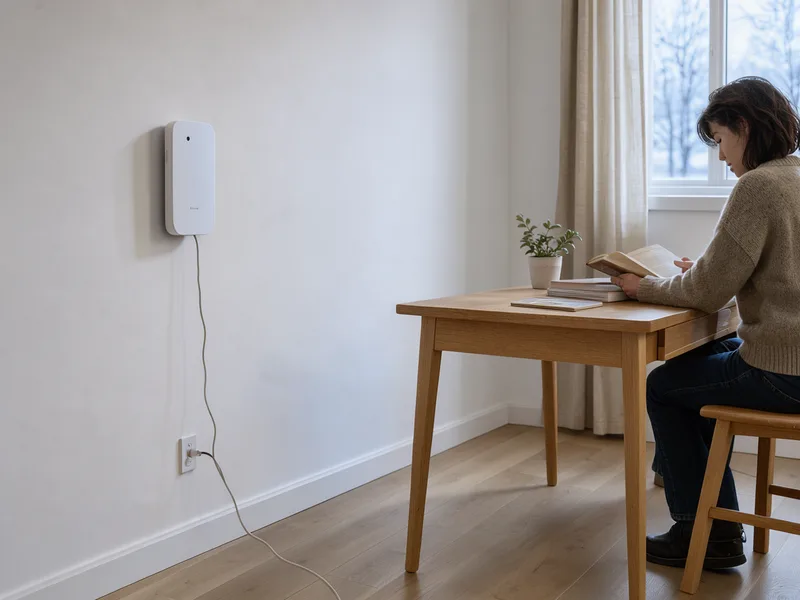
A 1,500 W panel on a standard 120 V outlet draws 12.5 amps (1,500 ÷ 120 = 12.5). A typical US residential circuit is rated for 15 or 20 amps. If the circuit already has lights, a computer, a lamp and a space heater on it, you are over the limit. The breaker will trip.
The safe rule: a 15-amp circuit can carry 1,800 W total (15 × 120 = 1,800). A 20-amp circuit can carry 2,400 W. If you want to plug in a 1,500 W panel, put it on a circuit that has nothing else drawing more than 300 W. A dedicated circuit is best.
If you need more than 1,500 W, a 240 V panel is the cleaner answer. A 2,000 W panel at 240 V draws only 8.3 amps (2,000 ÷ 240 = 8.3), which fits easily on a double-pole 15-amp breaker. But 240 V work requires a licensed electrician in most US jurisdictions. Do not attempt it yourself unless your local code allows it and you know what you are doing.
What it costs to run
Here is the formula. Take the panel's wattage, multiply by the hours you run it per day, multiply by 30 days, divide by 1,000 to get kilowatt-hours, then multiply by your electricity rate in cents per kWh.
Example: a 1,500 W panel running 6 hours a day at 15 cents per kWh.
1,500 × 6 × 30 = 270,000 watt-hours = 270 kWh 270 kWh × $0.15 = $40.50 per month
If your rate is 12 cents, it is $32.40. If your rate is 20 cents, it is $54.00. Check your electric bill for the actual rate. It is usually listed as "price per kWh" or "generation charge plus delivery charge."
A 400 W panel running 8 hours a day at 15 cents costs $14.40 per month. A 2,000 W panel running 5 hours a day at 15 cents costs $45.00 per month.
These numbers are for supplemental heat in one room. They are not a whole-house heating bill. If you are trying to heat an entire basement with panels, multiply accordingly and compare against a mini split, which delivers 2 to 3 times more heat per watt of electricity.
Monthly running cost for your panel
Enter your panel wattage, daily run hours and electricity rate to see what the panel adds to your monthly bill.
Monthly cost $
| Option | Best for | Typical cost to run (1,500 W, 6 hrs/day, 15¢/kWh) | Floor space | Dust or noise |
|---|---|---|---|---|
| Infrared panel (wall-mounted) | One room, quiet heat, no floor space | $40.50/month | None (wall or ceiling) | Silent, no fan |
| Space heater (ceramic or oil-filled) | Short bursts, one person, low budget | $40.50/month | Takes floor space | Fan noise (ceramic), silent (oil-filled) |
| Electric baseboard | Permanent heat, whole room convection | $40.50/month | Takes wall length | Silent, can stir dust |
| Ductless mini split | Heating a large or whole basement efficiently | $15 to $20/month (COP 2.5 to 3) | Wall unit, no floor space | Quiet fan, some air movement |
| Portable oil-filled radiator | Slow, steady warmth in a small room | $40.50/month | Takes floor space | Silent, no fan |
When a panel is the wrong choice
I will be straight with you. An infrared panel is not always the best answer for a basement.
If you need to heat the entire basement floor, a ductless mini split is more efficient. A mini split moves heat rather than creating it, so it delivers 2 to 3 times more warmth per watt of electricity. For a 400 or 600 square foot basement, a 9,000 or 12,000 BTU mini split will cost less to run than panels covering the same area.
If you only need warmth for one hour a day while you do laundry, a $40 space heater is fine. You do not need a $300 panel for an hour of use.
If your basement has a ceiling under 7 feet, a wall-mounted panel may not have enough clearance to work well, and a ceiling panel will feel too close. A small oil-filled radiator or a compact ceramic heater on a shelf may be more practical.
If the room is damp, fix the moisture first. A panel will not solve a condensation problem, and running it in a damp room without addressing the source wastes money.
What to look for when you buy
Every panel you install should carry a UL, ETL or CSA listing. That means a recognized testing lab has verified it meets US electrical safety standards. If a panel has no listing, do not buy it.
Check the surface temperature spec. Most panels run between 140 and 200°F on the face. That is hot enough to burn if you touch it, but not hot enough to ignite nearby materials if you follow the clearance instructions. Panels with a face temperature under 140°F are safer around children and pets but deliver less radiant output.
Check the warranty. A good panel should carry at least a 5-year warranty on the heating element. Some carry 10 years. A panel with no warranty or a 1-year warranty is a risk.
Check the mounting hardware. Some panels come with a bracket and screws. Others require you to buy the bracket separately. Factor that into your cost.
Common questions about basement infrared panels
Can I plug an infrared panel into a regular outlet?
Yes, if the panel is rated for 120 V and draws 12.5 amps or less (that is 1,500 W). Put it on a dedicated circuit or a circuit with very little other load. A 15-amp circuit tops out at 1,800 W total, so do not share it with a space heater, a hair dryer or a shop vacuum.
Do I need an electrician?
For a plug-in 120 V panel, no. For a 240 V hardwired panel, yes in most US jurisdictions. The electrician will run a new circuit from your panel box with a double-pole breaker and the correct wire gauge. Expect $200 to $500 for the circuit work if your panel box has room.
Will a panel heat my whole basement?
Not efficiently. A panel is a zone heater. It warms the people and surfaces in its line of sight. For a large open basement, you would need several panels and the running cost would exceed a mini split. Use a panel for one room or one seating area.
Does it work with a thermostat?
Yes. Most panels pair with a line-voltage thermostat (wired in series with the panel) or a smart plug with a temperature sensor. Set the thermostat to 64 to 66°F. You will feel warm at that air temperature because the panel heats your body directly.
Is it safe near drywall and insulation?
Yes, if you follow the clearance spec. Most panels need 3 inches of clearance on all sides. The surface temperature is 140 to 200°F, which is below the ignition point of drywall paper and fiberglass insulation. Do not mount a panel directly against foam insulation or anything that can melt.
Can I use one in a bathroom?
Yes, if the panel is rated for damp locations (look for an IP rating of IPX4 or higher). A bathroom panel should be mounted away from the shower or tub splash zone. Check local code for GFCI requirements.